

-
21 intervenir
v.1 to tap.El tipo interviene el proyecto The guy tap the project.2 to seize (incautarse de).3 to audit (finance) (cuentas).La contraloría interviene a la empresa The comptroller audits the company.4 to take part.intervino en varias películas cómicas (en discusión, debate) she appeared in several comedy filmsen la evolución de la economía intervienen muchos factores several different factors play a part in the state of the economydespués del presidente intervino el Sr. Ramírez Mr Ramirez spoke after the president5 to intervene (interferir, imponer el orden).El juez interviene a veces The judge intervenes sometimes.6 to operate on, to perform surgery on, to make an intervention on.Te interviene el Dr. Pérez Dr. Perez makes an operation on you.7 to take over, to take control of, to take over the operation of.El socio interviene la empresa The associate takes over the operation of..8 to confiscate, to seize.La corte interviene sus bienes The court seized his belongings.* * *1 (tomar parte) to take part (en, in); (mediar) to intervene2 (interrumpir) to intervene3 (hablar) to speak (en, at)1 MEDICINA to operate on2 (alijo, mercancía) to seize3 (teléfono) to tap4 (cuentas) to audit* * *verb1) to intervene2) take part3) operate* * *1. VI1) (=tomar parte) to take partla reyerta en la que intervino el acusado — the brawl in which the defendant took part o was involved
2) (=injerirse) to intervenela policía intervino para separar a las dos pandillas — the police intervened to separate the two gangs
3) (=mediar)el presidente intervino para que se pudiera llegar a un acuerdo — the president mediated o interceded so that an agreement could be reached
las circunstancias que intervinieron en mi dimisión — the circumstances that influenced my resignation
2. VT1) (=controlar) to take over, take control ofla junta militar intervino todas las cadenas estatales — the junta took over o took control of all the state-run channels
el gobierno intervino a los ferroviarios — the government took over o took control of the railworkers' union
2) (Com) [+ cuenta] to audit; [+ banco, empresa] to take into administration; [+ cuenta, bienes] to freeze3) (Med) to operate on4) [+ droga, armas, patrimonio, bienes] to confiscate, seize5) [+ teléfono] to tap* * *1.verbo intransitivoa) (en debate, operación) to take part; ( en espectáculo) to appear, performb) ( mediar) to intervene, intercede (frml)c) ( tomar parte) to intervene2.intervenir vt1)a) < teléfono> to tapb) ( tomar control de) < empresa> to place... in administrationc) ( inspeccionar) < cuentas> to audit, inspectd) <armas/droga> to seize, confiscatee) (AmL) <universidad/emisora> to take over the running of, take control of2) ( operar) to operate on* * *= go into, have + a hand in, step in, intervene, jump in, obtrude (into), cut in, mediate, intersect, come into + play, call into + play, wiretap [wire-tap], weigh in, chime in.Ex. As something you may or may not know, every item going into the processing stream is assigned a priority, and our judgment will in many cases be different from yours, as our needs will be different from yours.Ex. For the benefit of all users of the thesaurus who have not had a hand in its initial compilation some written record describing the anticipated use of the thesaurus is valuable.Ex. Furthermore, children can be misled by group influences into reading truly pernicious material (hard core ponography, for example) and when this happens adults have a clear responsibility to step in and do something about it.Ex. And again, this is a point at which the teacher may need to intervene to provide examples.Ex. The unhappy tendency among teachers -- an occupational neurosis -- is to jump in too early and too often, especially if the talk wanders from direct comments about books under consideration.Ex. The librarian will provide whatever help is required without obtruding into the process.Ex. 'I'm not sure what 'arbitrary and capricious' means,' Stanton cut in reasonably.Ex. School library media professionals who mediate in the learning experiences of students must be well informed critical thinkers.Ex. Contingency plans can be devised to intersect at several points on this time continuum.Ex. There are, of course, all sorts of other considerations which come into play in determining the income which a publisher might obtain from a book.Ex. Ethical principles are called into play when deliberating about values, particularly when values run into conflict.Ex. The implementation of this system would enable law enforcement agencies to wiretap all digital communication.Ex. If Division VIII is best positioned to weigh in on terminology, Division VIII should do so and the rest of us should follow that lead.Ex. A few members of this list have done this, so wait for them to chime in here.----* intervenir con = chime in with.* intervenir en un conflicto = enter + conflict.* que intervienen = at play.* si no intervienen otros factores = ceteris paribus, all (other) things being equal.* * *1.verbo intransitivoa) (en debate, operación) to take part; ( en espectáculo) to appear, performb) ( mediar) to intervene, intercede (frml)c) ( tomar parte) to intervene2.intervenir vt1)a) < teléfono> to tapb) ( tomar control de) < empresa> to place... in administrationc) ( inspeccionar) < cuentas> to audit, inspectd) <armas/droga> to seize, confiscatee) (AmL) <universidad/emisora> to take over the running of, take control of2) ( operar) to operate on* * *= go into, have + a hand in, step in, intervene, jump in, obtrude (into), cut in, mediate, intersect, come into + play, call into + play, wiretap [wire-tap], weigh in, chime in.Ex: As something you may or may not know, every item going into the processing stream is assigned a priority, and our judgment will in many cases be different from yours, as our needs will be different from yours.
Ex: For the benefit of all users of the thesaurus who have not had a hand in its initial compilation some written record describing the anticipated use of the thesaurus is valuable.Ex: Furthermore, children can be misled by group influences into reading truly pernicious material (hard core ponography, for example) and when this happens adults have a clear responsibility to step in and do something about it.Ex: And again, this is a point at which the teacher may need to intervene to provide examples.Ex: The unhappy tendency among teachers -- an occupational neurosis -- is to jump in too early and too often, especially if the talk wanders from direct comments about books under consideration.Ex: The librarian will provide whatever help is required without obtruding into the process.Ex: 'I'm not sure what 'arbitrary and capricious' means,' Stanton cut in reasonably.Ex: School library media professionals who mediate in the learning experiences of students must be well informed critical thinkers.Ex: Contingency plans can be devised to intersect at several points on this time continuum.Ex: There are, of course, all sorts of other considerations which come into play in determining the income which a publisher might obtain from a book.Ex: Ethical principles are called into play when deliberating about values, particularly when values run into conflict.Ex: The implementation of this system would enable law enforcement agencies to wiretap all digital communication.Ex: If Division VIII is best positioned to weigh in on terminology, Division VIII should do so and the rest of us should follow that lead.Ex: A few members of this list have done this, so wait for them to chime in here.* intervenir con = chime in with.* intervenir en un conflicto = enter + conflict.* que intervienen = at play.* si no intervienen otros factores = ceteris paribus, all (other) things being equal.* * *intervenir [ I31 ]vi1 (en un debate) to take part; (en un espectáculo) to appear, perform; (en una operación) to take partintervino ante el director a nuestro favor she intervened o interceded on our behalf with the directoren mi decisión han intervenido muchos factores many factors have had a bearing on my decision3 (involucrarse, inmiscuirse) to intervene, get involvedno pensamos intervenir en los problemas internos de otros países we do not intend intervening o getting involved in the internal affairs of other countrieslos profesores tuvieron que intervenir en la pelea the teachers had to intervene to stop the fightno quiso intervenir en la pelea he didn't want to get involved in the fight■ intervenirvtA1 ‹teléfono› to tap2 (tomar control de) ‹empresa› to place … in administration3 (inspeccionar) ‹cuentas› to audit, inspect4 ‹armas/droga› to seize, confiscate5 ( AmL) ‹universidad/emisora› to take over the running of, take control ofB (operar) to operate onfue intervenido en una clínica privada he had his operation o he was operated on o he underwent surgery in a private clinic* * *
intervenir ( conjugate intervenir) verbo intransitivo
( en espectáculo) to appear, perform
intervenir en una pelea to intervene o step in to stop a fight;
( involucrarse) to get involved in a fight
verbo transitivo
1
2 ( operar) to operate on;
intervenir
I vi (mediar) to intervene [en, in]
(participar) to take part [en, in]: me gustaría intervenir en el debate, I'd like to take part in the debate
II verbo transitivo
1 (un alijo de droga, etc) to confiscate, to seize: la policía ha intervenido la droga en la frontera, the police seized the drugs at the border
2 (bloquear una cuenta bancaria) to block o freeze: el juez ha intervenido su cuenta, the judge froze his bank account
(auditar) to audit
3 (un teléfono) to tap: me parece que la línea está intervenida, I think they put a tap on our phone
4 Med (a un paciente) to operate on: le van a intervenir mañana a las nueve, they're performing her surgery tomorrow at nine o'clock
' intervenir' also found in these entries:
Spanish:
mediar
- terciar
English:
intervene
- join in
- step in
- interest
- move
- operate
- step
- tap
* * *♦ vt3. [teléfono, línea] to tap;[correspondencia] to open4. [incautarse de] to seize5. Am [institución privada] to put into administration♦ vi1. [participar] to take part (en in); [en pelea, discusión] to get involved (en in);intervino en varias películas cómicas she appeared in several comedy films;en la evolución de la economía intervienen muchos factores several different factors play a part in the state of the economy;después del presidente intervino el Sr. Ramírez Mr Ramirez spoke after the president;yo quisiera intervenir para decir que no estamos de acuerdo con la propuesta I would just like to say something: we do not agree with the proposal;¿alguien más quisiera intervenir sobre esta cuestión? would anyone else like so say something on this issue?2. [interferir, imponer el orden] to intervene (en in);la policía tuvo que intervenir para separar a las dos aficiones the police had to intervene to separate the two groups of fans3. [mediar] to intervene, to intercede;su padre intervino ante su madre para que lo dejara salir his father spoke to his mother to persuade her to let him go out;la ONU intervino para lograr un acuerdo the UN intervened o interceded in order to get an agreement* * *II v/t1 TELEC tap2 contrabando seize3 MED operate on* * *intervenir {87} vi1) : to take part2) interceder: to intervene, to intercedeintervenir vt1) : to control, to supervise2) : to audit3) : to operate on4) : to tap (a telephone)* * *intervenir vb1. (interponerse) to intervene3. (operar) to operate on -
22 preselección
f.1 preselection, short list, shortlist.2 prescreen, prescreening.* * *SF1) (Dep) (=acción) seeding; (=equipo) squad, team2) [de candidatos, participantes] shortlist, shortlisting* * *una vez terminada la preselección — once the initial selection process is/was complete
* * *= preselection [pre-selection], prescreening.Ex. Proposes that search services should concentrate on a quality control programme which would begin before training, at the preselection stage.Ex. If a point system can be created, the prescreening stage is greatly simplified.* * *una vez terminada la preselección — once the initial selection process is/was complete
* * *= preselection [pre-selection], prescreening.Ex: Proposes that search services should concentrate on a quality control programme which would begin before training, at the preselection stage.
Ex: If a point system can be created, the prescreening stage is greatly simplified.* * *1(de candidatos): hemos hecho una preselección de los candidatos we have drawn up a shortlist of candidatesuna vez terminada la preselección once the initial selection process is/was complete2 ( Tec) preselection* * *
preselección sustantivo femenino:
una vez terminada la preselección once the initial selection process is/was complete
* * *preselección nftuvimos que hacer una preselección we had to draw up a short list;no pasó de la fase de preselección he didn't get beyond the initial selection stage -
23 точка
dot, period вчт., full point полигр., point, site, spot, ( знак препинания) full stop* * *то́чка ж.1. мат. pointв то́чке — at (the) point …взять отме́тку то́чки геод. — take a point, determine [establish] the elevation of a pointисходи́ть из то́чки — issue [radiate, extend, emanate] from a pointпереводи́ть то́чку из положе́ния x0 в положе́ние x1 киб. — steer x0 to x1с вы́кинутой то́чкой — punctured (e. g., of an interval)2. ( графический знак) dot3. ( температурный предел) point4. ( затачивание) grinding, sharpeningто́чка аэросни́мка, гла́вная — principal point of an aerial photographнаходи́ть гла́вную то́чку аэросни́мка — locate the principal point of an aerial photographба́зисная то́чка — base mark, base pointбарометри́ческая то́чка — barometrical (levelling) pointбесконе́чно удалё́нная то́чка — point at infinity, infinite point, infinityвзаи́мно обра́тная то́чка — inverse pointвзаи́мно сопряжё́нная то́чка — conjugate pointто́чка визи́рования — point of sight, aiming [bearing, sighting] pointвнеосева́я то́чка — extra-axis pointто́чка воды́, тройна́я — triple point of waterто́чка воспламене́ния — ignition pointто́чка вспы́шки — flash pointто́чка вхо́да в програ́мму или подпрогра́мму вчт. — entry point to a program or a subprogramто́чка вы́хода на орби́ту — point of injection into orbitгла́вная то́чка — principal pointдиакрити́ческая то́чка ( на кривой намагничивания) — diacritical pointто́чка зажига́ния — firing pointто́чка заме́ра — measuring point; measuring stationто́чка замерза́ния — freezing pointто́чка засто́я мех. — stagnation pointто́чка затвердева́ния — solidification pointто́чка затвердева́ния зо́лота — gold pointто́чка затвердева́ния серебра́ — silver pointто́чка зени́та — zenith pointзерка́льная то́чка — mirror pointто́чка зре́ния — point of view, standpointиденти́чная то́чка топ. — conjugate [homologous image, matching] pointто́чка изло́ма криво́й — breakpointизобража́ющая то́чка — representative pointизоли́рованная то́чка — isolated point, acnodeто́чка испаре́ния — evaporating [vaporization] pointисхо́дная то́чка — datum [reference] point, origin; геод., топ. main base, head-of-the-line, initial [starting] pointкардина́льная то́чка опт. — cardinal pointто́чка каса́ния — point of tangencyто́чка каса́ния Земли́ ( самолетом) — touch-down pointто́чка кипе́ния — boiling pointповыша́ть то́чку кипе́ния — elevate the boiling point (of …)пони́жать то́чку кипе́ния — depress the boiling point (of …)то́чка кипе́ния, нача́льная — initial boiling pointто́чка конверге́нции геод., картогр. — convergence pointконденсацио́нная то́чка — condensation pointконе́чная то́чка1. геод., топ. finishing [terminal] point2. ( титрования) end pointто́чка конта́кта — contact pointконтро́льная то́чка — check pointкра́тная то́чка — multiple pointкрити́ческая то́чка1. critical point2. аргд. stagnation pointкрити́ческая то́чка при охлажде́нии метал. — Ar -pointто́чка Кюри́, магни́тная — Curie point, magnetic transition temperatureто́чка магистра́ли, нача́льная геод. — initial mark of the base (line)материа́льная то́чка — material point, particleмё́ртвая то́чка1. ( трубопровода) anchoring point2. ( движения поршня) dead centreмё́ртвая, ве́рхняя то́чка — top dead centreмё́ртвая, ни́жняя то́чка — bottom dead centreто́чка минима́льного подхо́да — the closest point of approachто́чка ми́нимума то́ка ( туннельного диода) — valley pointто́чка наблюде́ния геод., топ. — point of observation, point of sight, point of view, aiming pointто́чка нади́ра — nadir point, photographic nadirто́чка насыще́ния — saturation pointнейтра́льная то́чка — neutral pointто́чка неопределё́нности мат. — ambiguous pointнеосо́бая то́чка мат. — regular [nonsingular] pointнивели́рная то́чка — point of level(ling), level(l)ing pointнулева́я то́чка — null [zero] pointнулева́я, иску́сственная то́чка эл. — artificial earthing pointопо́рная то́чка — (point of) controlопо́рная, высо́тная то́чка — vertical control pointопо́рная, пла́новая то́чка — horizontal [plan] control pointто́чка опо́ры — point of support, point of bearing, supporting point, fulcrumто́чка осажде́ния — precipitation pointосо́бая то́чка мат. — singular point, singularityто́чка отбо́ра электропита́ния (особ. для бытовых приборов) — convenience outletотождествлё́нная то́чка — conjugate [homologous image, matching] pointто́чка отры́ва пото́ка аргд. — separation [break-away] pointто́чка переги́ба криво́й — inflection point, point of inflectionто́чка пересече́ния — intersection point, cross-point, point of intersectionто́чка перехо́да — transition pointто́чка перехо́да в жи́дкую фа́зу — liquefaction pointто́чка плавле́ния — melting [fusion] pointто́чка поворо́та — turning pointпограни́чная то́чка — boundary pointто́чка подключе́ния ( в теории цепей) — terminalто́чка поко́я — stationary [rest] point, point of restполигонометри́ческая то́чка — transit [traverse, polygonometric] pointто́чка полови́нной мо́щности — half-power pointто́чка помутне́ния — cloud pointпотенциа́льно заземлё́нная то́чка — брит. virtual earth; амер. virtual groundто́чка превраще́ния — transformation pointто́чка привя́зки геод., топ. — point of reference, junction [tie] pointто́чка приложе́ния нагру́зки — load pointто́чка приложе́ния подъё́мной си́лы — lift centre, centre of liftто́чка приложе́ния си́лы — point of application, force pointрабо́чая то́чка ( на характеристике радиолампы) — operating [quiescent, Q] pointто́чка равнове́сия — equilibrium pointто́чка разветвле́ний — branch point; ( на структурных схемах систем регулирования) (data) take-off pointто́чка разветвле́ния схе́мы — junction point of a networkто́чка размягче́ния — softening pointто́чка разры́ва непреры́вности аргд. — discontinuity (point)ра́стровая то́чка полигр. — screen [half-tone] dotто́чка ре́перная то́чка1. datum [reference] point2. ( термометра) fixed pointто́чка росы́ — dew pointсварна́я то́чка — spot weld, weld spotто́чка сво́да, вы́сшая — roof crownседлова́я то́чка мат. — saddle pointто́чка сма́зки — lubrication pointто́чка с нулевы́м потенциа́лом — point at zero potential, datum pointсоотве́тственная то́чка топ. — conjugate [homologous image, matching] pointсопряжё́нная то́чка — conjugate pointсре́дняя то́чка — midpointсре́дняя то́чка на обмо́тке (напр. трансформатора) — centre tapто́чка сры́ва пото́ка аргд. — separation [burble] pointто́чка стеклова́ния — glass-transition pointто́чка стоя́ния геод., топ. — point of observation, point of sight, point of view, aiming pointсумми́рующая то́чка ( в операционном усилителе) — summing junctionто́чка схо́да мат. — vanishing pointсчисли́мая то́чка навиг. — dead-reckoning [D.R.] positionто́чка та́яния — melting pointто́чка теку́чести — flow pointтройна́я то́чка — triple pointузлова́я то́чка мат. — nodal point, nodeустано́вочная то́чка — work pointто́чка шарни́ра — hinge pointэвтекти́ческая то́чка — eutectic pointэквивале́нтная то́чка ( в титровании) — equivalence point -
24 положение
position
- (летательного аппарата в пространстве в полете или на земле) — attitude. the position or orientation of an aircraft, either in flight motion or at rest.
-, боковое (ла в горизонтальной плоскости относительно равносигнапьной зоны крм) — lateral displacement
-, боковое (ла относительно линии заданного азимута) — azimuth deviation
-, взлетное — takeoff position
- "включено" (выкпючателя) — on position
- "выключено" — off position
-, выпущенное — extended position
- гироскопа в (инерциальном) пространстве — orientation of gyro in inertial space
to maintain gyro orientation in inertial space.
- закрылка(ов) — flap position /setting/
- закрылков, взлетное — flap takeoff position
- закрылков для захода на посадку — flap approach position
- закрылков, полетное — flap enroute position
- закрылков, полностью выпущенное — flap fully extended position
- закрылков, полностью убрапное — flap fully retracted position
- закрылков, посадочное — flap landing position, flaps in landing configuration /position, setting/
закрылки устанавливаются в посадочное положение непосредственно перед выполнением посадки. — flaps must be in landing position from the point immediately before landing.
- "закрыто" — closed position
- звезды, расчетное — computed star location (to calculate actual position)
- звезды, фактическое — actual star location
-, исходное — initial position
-, кажущееся — apparent position
-, крайнее — extreme position
-, крайнее заднее — extreme /full/ rear position
установить рычаг управления из крайнего заднего в крайнее переднее положение. — move the control lever from the extreme rear position to full forward position.
-, крайнее переднее — extreme /full/ forward position
-, критическое — critical condition
-, крейсерское (элерона-зaкрылка) — cruise position
-, маневренное (элерона-закрылка) — maneuvers position
-, начальное — initial position
-, нейтральное — neutral position
-, нивелировочное — rigging position
установка самолета в линию горизонтального полета без крена. — rigging position is an aircraft attitude in which the lateral axis is horizontal and an arbitrary longitudinal datum line is also horizontal.
-, новое — new position
-, нормальное полетное — normal flight attitude
-, нулевое (в гироприборах, маятника акселерометра) — null position. то drive the gyro rotor to a null position.
-, нулевое (о показаниях прибора) — zero reading
-, опасное — dangerous condition
- "открыто" (напр., крана) — open position
- переключателя "а" обеспечивает автоматическое управление (напр., выбором ппм) — switch position activatas /ontails, enables/ automatic seisction (of route legs)
-, первоначальное — original position
- no крену — roll attilade
- no курсу — yaw attitude
- no тангажу — pitch attitude
af the desired pitch attitude.
- покоя — position at rest
-, полетное (самолета) — flight altitude
-, полетное (элементов управления) — en route position, airmjrne раsition
-, походное — stowed position, stowage
-, промежуточное (о створках или шасси, находящихся в движении на уборку или выпуск) — in-transit position. the red door and intransit (in trans) ligilts will be illulninated if any gear door is open.
-, рабочее (напр., прибора или поверочного пульта) — operating position
-, расчетное (местоположение ла) — computed position
- руд (рычага управления двиг.) — throttle setting /position/
- рычага — lever position
- рычага управления двигате лем (руд) — throttle position
- (местоположение) самолета — аircraft present position (pos)
- самолета, обеспечивающее максимальную плавучесть после посадки на воду — best notation attitude. a forward cg, within cg limits, provides best notation attitude when the airplane comes to rest in the water.
- (местоположение) самолета, текущее — aircraft present position (pos)
-, сбалансированное (самолета) — trimmed attitude
- сектора газа — throttle position /setting/
- складывающегося подноса (шасси) с образованием "стрелы" прогиба, фиксиро ванное — folding strut over center locked position
-, среднее (напр., переключателя, задатчика) — mid position
set zone temperature selector to mid position.
-, стояночное (самолета) — static ground position
-, стояночное (при посадке вертолета) — level attitude
-, убранное (шасси, закрылков) — retracted position
-, убранное (походное) — stowed position
-, угловое — angular position
-, установочное (прибора, агрегата) — mounting attitude
-, установленное (рычага управления) — set position. each control must be able to maintain any set position.
-, фиксированное — locked position
-, фиксированное (рычага уnравнения) (рис. 57) — detent position
рычаг крана останова двигателя имеет три фиксированных положения: стоп, запуск, работа. — each hp cock control lever has detent positions, off, start, run.
-, флюгерное (воздушного винта) (рис.58) — (ropeller) feathered position
-, чрезвычайное — state of emergency
- шасси — landing gear position
в закрытом (открытом) п. — in closed (open) position
возвращение стрелки (прибоpa) в исходное (нулевое) п. — pointer return to initial (zero) position
возвращаться в исходное п. (о системе автоматики, предохранительном устройстве) — reset
выводить из нейтрального п. — move from the neutral position
заедать в закрытом (открытом) п. — be stuck closed (open)
занимать правильное п. (самостоятельно) — right itself. capsized liferaft should right itself.
изменять п. — change the position
изменять п. (органа управления, переключателя) — reposition the contr switch)
не находиться в какомлибо п. — be off position
не находиться в нулевом п. (о стрелке прибора) — be off zero point. note number of degrees, with pointer off zero point.
оставаться в п. — remain in the position
оставаться в горизонтальном п. — remain level
принимать требуемое п. в пространстве — assume proper attitude
сохранять горизонтальное п. — keep level
ставить в... п. — set... to position
устанавливать (оборудование) в походное п. — stow (equipment), place (equipment) in stowage
устанавливать самолет в горизонтальное п. — level the airplane
фиксировать в закрытом (открытом) п. — lock closed (open)Русско-английский сборник авиационно-технических терминов > положение
-
25 ajuste
m.1 fitting.ajuste de cuentas settling of scores2 adjustment, setting, fix, adjusting.3 fit.4 final touch, smoothing.5 imposition, enactment.pres.subj.3rd person singular (él/ella/ello) Present Subjunctive of Spanish verb: ajustar.* * *1 (unión) adjustment, fitting2 TÉCNICA assembly3 COMERCIO settlement, fixing4 (tipografía) make-up, composition\ajuste de cuentas figurado settling of scores* * *noun m.* * *SM1) (Téc) adjustmentcarta 7)¿cómo se hace el ajuste del brillo en este televisor? — how do you adjust the brightness on this television?
2) (=adaptación) adjustmentajuste de plantilla — Esp redeployment of labour o (EEUU) labor
ajuste laboral — redeployment of labour o (EEUU) labor
3) (=pacto)4) (Cos)5) (Tip) composition, make-up6) (Jur) (=honorarios) retaining fee; (=sobrepaga) bonus7) Méx [de motor] overhaul* * *1)a) ( apretamiento) tightening (up)b) ( regulación) adjustment2) (de gastos, horarios) readjustment; ( de sueldos) adjustment3) ( de precio) fixing•* * *= adjustment, alignment, customisation [customization, -USA], fine tuning [fine-tuning], tightening up, tweaking, tailoring, tweak, tightening, refinement.Ex. Even in situations where there is a published list covering the requirements of the type of library to be indexed, this list is likely to require adjustment in order to make it compatible with local requirements.Ex. Word processing packages must be able to permit the user to manipulate test, as is necessary in alignment of margins, insertion and deletion of paragraphs, arrange for text to appear in the centre of the page and underline.Ex. The evaluation model therefore is subject to a degree of customisation to adapt it to the project environment.Ex. A second important purpose was to facilitate the initial ' fine tuning' of the system following its initial deployment.Ex. This appears to be a tightening up of the definition rather than a new approach.Ex. The PCC intends that Program records, full or core, represent acceptable bibliographic control such that record ' tweaking' at the local level is minimized.Ex. To haul themselves out of their bog, their networks must facilitate tailoring of records to meet local needs.Ex. This system simultaneously searches the Web and a large, multidisciplinary, full text database, using a relevance system with some clever tweaks.Ex. Previous policies allowed professional interaction but recent tightening has made that more difficult.Ex. Also search strategy can be modified relatively easily, where only refinements or slight modifications in index terms are appropriate.----* ajuste de cuentas = grudge fight, grudge match, settling of scores.* ajuste de la componente estacional = seasonal adjustment.* ajuste estacional = seasonal adjustment.* buen ajuste = good fit.* hacer ajustes = make + adjustment.* hacer pequeños ajustes = tinker + around the edges, tinker with.* pequeños ajustes = tinkering.* * *1)a) ( apretamiento) tightening (up)b) ( regulación) adjustment2) (de gastos, horarios) readjustment; ( de sueldos) adjustment3) ( de precio) fixing•* * *= adjustment, alignment, customisation [customization, -USA], fine tuning [fine-tuning], tightening up, tweaking, tailoring, tweak, tightening, refinement.Ex: Even in situations where there is a published list covering the requirements of the type of library to be indexed, this list is likely to require adjustment in order to make it compatible with local requirements.
Ex: Word processing packages must be able to permit the user to manipulate test, as is necessary in alignment of margins, insertion and deletion of paragraphs, arrange for text to appear in the centre of the page and underline.Ex: The evaluation model therefore is subject to a degree of customisation to adapt it to the project environment.Ex: A second important purpose was to facilitate the initial ' fine tuning' of the system following its initial deployment.Ex: This appears to be a tightening up of the definition rather than a new approach.Ex: The PCC intends that Program records, full or core, represent acceptable bibliographic control such that record ' tweaking' at the local level is minimized.Ex: To haul themselves out of their bog, their networks must facilitate tailoring of records to meet local needs.Ex: This system simultaneously searches the Web and a large, multidisciplinary, full text database, using a relevance system with some clever tweaks.Ex: Previous policies allowed professional interaction but recent tightening has made that more difficult.Ex: Also search strategy can be modified relatively easily, where only refinements or slight modifications in index terms are appropriate.* ajuste de cuentas = grudge fight, grudge match, settling of scores.* ajuste de la componente estacional = seasonal adjustment.* ajuste estacional = seasonal adjustment.* buen ajuste = good fit.* hacer ajustes = make + adjustment.* hacer pequeños ajustes = tinker + around the edges, tinker with.* pequeños ajustes = tinkering.* * *A1 (apretamiento) tightening (up)2 (regulación) adjustment3 (de páginas) makeup, compositionCompuesto:( Inf) word wrapB1 (de gastos, horarios) readjustmentajuste de plantilla redeployment of labor/staff2 (de sueldos) adjustmentC (de precio) fixingsólo falta el ajuste del precio all that remains is to fix the priceCompuesto:settling of scores* * *
Del verbo ajustar: ( conjugate ajustar)
ajusté es:
1ª persona singular (yo) pretérito indicativo
ajuste es:
1ª persona singular (yo) presente subjuntivo3ª persona singular (él/ella/usted) presente subjuntivo3ª persona singular (él/ella/usted) imperativo
Multiple Entries:
ajustar
ajuste
ajustar ( conjugate ajustar) verbo transitivo
1
2 ( en costura) to take in
3a) ‹gastos/horarios› ajuste algo a algo to adapt sth to sth
4 ( concertar) to fix, set
5 ‹ cuentas› ( sacar el resultado de) to balance;
( saldar) to settle
verbo intransitivo
to fit
ajustarse verbo pronominal
1 ( refl) ‹ cinturón de seguridad› to adjust
2 [ piezas] to fit
ajustar verbo transitivo
1 to adjust
2 (apretar) to tighten
(encajar) to fit
3 Fin (cuenta) to settle
♦ Locuciones: figurado ¡ya te ajustaré las cuentas!, I'll get even with you!
ajuste sustantivo masculino
1 adjustment
2 (económico) settlement
figurado ajuste de cuentas, settling of scores
' ajuste' also found in these entries:
English:
adjust
- adjustment
- fit
- setting
* * *ajuste nm1. [de pieza] fitting;[de mecanismo] adjustment2. [ecónomico]ajuste de plantilla downsizing;las medidas de ajuste económico propuestas por el gobierno the economic measures proposed by the governmentajustes presupuestarios budget adjustments;ajuste salarial wage adjustment3. RDom, Ven [pago único] = agreed payment for a piece of workle va mal porque no hizo ajuste con los poderosos de turno it's going badly for him because he didn't square things o do a deal with those in power at the time5. Fig ajuste de cuentas:los ajustes de cuentas son frecuentes entre bandas rivales the settling of scores is common amongst rival gangs;murió en un ajuste de cuentas he died in a tit-for-tat killing* * *m adjustment;ajuste de cuentas settling of scores* * *ajuste nm1) : adjustment2) : tightening* * *ajuste n adjustment -
26 угол (геометрический)
angle
- (кабины, панели) — corner
указатель установлен в верхнeм левом углу приборной доски. — the indicator is located on the upper left corner of the instrument panel.
- (при определении географических и навигационных параметров) — angle, angular distance
- (эл. сигнал, соответствующий угловой величине) — angular information the angular information is supplied to the stator windinq.
- азимута (e) — azimuth
-, азимутальный (в полярных координатах) — azimuth angle
угловая величина, отсчитываемая по часовой или против часовой стрелки от северного или южного направления от о град, до 90 или 180 град. — measured from 0о at the north or south reference direction clockwise or counterclockwise through 90о or 180о.
-, азимутальный (курс) — azimuth
- азимутальный (гироппатфор'мы), отсчитываемый от местного географического меридиана — stable platform azimuth angle measured from local geographic meridian
- азимутальный, направленно' гo луча антенны — azimuth angle of antenna beams
- атаки (а) — angle of attack (alpha, aat)
угол, заключенный между линией отсчета, жестко связанной с планером (крылом) самолета и направлением движения ла. — the angle between a referелее line fixed with respect to an airframe and a lipe in the direction of the aircraft.
лампа сигнализации выключенного обогрева автомата угпа атаки. (ауасп обогр. выкл.) — alpha off light
- атаки (англ. термин) — angle of incidence (british usage)
- атаки, индуктивный — induced angle of attack
составная часть любого текущего угла атаки, превышающая эффективный угол атаки. — а part of any given angle of attack over and above the effective angle of attack.
- атаки крыла (профиля) — wing angle оf attack
угол, заключенный между хордой профиля и направлением набегающего потока воздуха (рис.135). — the angle between the chord line of the wing (airfoil) and the relative airflow.
- атаки, большой — high angle of attack
- атаки, вызывающий срабатывание системы предотвращения сваливания (выхода на критический угол атаки) — stall barrier actuation angle of attack. the system suppresses the stall warning and barrier асtuation angles of attack to prevent stall overshoot.
- атаки, докритический — pre-stall(ing) angle of attack
- атаки, закритический — angle of attack beyond stall
- атаки, критический, — angle of sfall, stalling angle, stall
угол атаки, соответствующий максимальному значению коэффициента подъемной силы. — the angle of attack correspending to the maximum lift coefficient.
- атаки, местный — local angle of attack
- атаки нулевой подъемной силы — zero lift angle of attack
- атаки, отрицательный — negative angle of attack
- атаки, положительный — positive angle of attack
- атаки, средний — medium angle of attack
- атаки, текущий (a тем) — present angle of attack
- атаки, эффективный — effective angle of attack
-, боевой магнитный путевой (бмпу) — run-in magnetic track angle /course/
- бокового скольжения — angle of sideslip
- ветра (ув) — wind angle (u)
угол, заключенный между вектором путевой скорости и вектором ветра (рис. 124). — the angle between the true course and the direction from which the wind is blowing, measured from the true course toward the right or left, from 0 to 180°.
- ветра, курсовой — wind angle
- взмаха — flapping angle
острый угол, образованный продольной осью лопасти неcyщeгo винта вертолета и плоскостью вращения втулки винта при повороте лопасти относительно горизонтальногo шарнира. — the difference between the coning angle and the instantaneous angle of the span axis of a blade of a rotary wing system relative to the plane perpendicular to the axis of rotation.
- видимости аэронавигационного огня (ано) (рис. 97) — navigation light dihedral angle
- видимости левого ано (угол "л") — navigation light dihedral angle l (left)
- видимости правого ано (угол "п") — navigation light dihedral angle r (riqht)
- видимости хвостового ано (угол "x") — navigation light dihedral angle a (aft)
- визирования — sight angle, angle of sight
- возвышения — angle of elevation, elevation
угол в вертикальной плоскости между горизонталью и наклонной линией от наблюдателя до объекта (рис. 129). — the angle in a vertical plane between the local horizontal and ascending line, as from an observer to an object.
- волнового конуса — mach angle
the angle between a mach line and the direction of movement of undisturbed flow.
- вращения — angle of rotation
- выставки телеблока — telescope /telescopic/ - sensor alignment angle
- гироппатформы, азимутапьный (инерциальной системы) — stable platform azimuth
- глиссады — glide slope angle
угол в вертикальной плоскости между глиссадой и горизонталью (рис. 120). — angle in vertical plane between the glide slope and the horizontal.
-, гринвичский часовой — greenwich hour angle (gha)
угол к западу от астрономического гринвичского меридиана. — angular distance west of the greenwich celestial meridian.
- датчика (угла) гироскопа — gyro-pickoff angle
-, двугранный (ано) — dihedral angle
- действия (см. видимости) — navigation light dihedral angle
-, заданный путевой (зпу) (рис. 124) — desired track angle (dsrtk) (dtk)
- заклинения (установки несущей поверхности) — angle of setting, rigging angle of incidence
фиксированный угол между плоскостью хорды крыла (стабилизатора) и продольной осью самолета (осью тяги) при горизонтальном положении самолета (рис. 135). — а fixed angle between the plane of the wing chord and the line of thrust or any other longitudinal line which is level when the fuselage is level longitudinally.
- заклинения горизонтального оперения — angle of stabilizer setting
острый угоп между продольной осью самолета и хордой (горизонтального) стабилизатора. угол является положительным при превышении передней кромки стабилизатора над задней. — the acute angle between the line of thrust of an airplane and the chord of the stabillzer. the angle is positive when the leading edge is higher than the trailing edge.
- заклинения крыла — angle of wing setting
острый угол между плоскостью хорды крыла и продольной осью самолета. угол является положительным при превышении передней кромки крыла над задней. — the acute angle between the plane of the wing chord and the longitudinal axis of the airplane. the angle is positive when the leading edge is higher than the trailing edge.
- заклинения крыла у корня — angle of wing setting at root
- заклинения крыльев (биплана) — decalaqe
разность между углами установки верхнего и нижнего крыльев. острый угол между линиями хорд крыльев в плоскости, параллельной плоскости симметрии самолета. — a difference in the angles of setting of the wings of a biplane. the decalage is measured by the acute angle between tfle chords in a plane parallel to the plane of symmetry.
- застоя (картушки компаса) — angular friction error (of compass card)
- затенения (огня), телесный — solid angle of obstructed (light) visibility
- зрения — angle of view
-, исходный путевой — initial departure track angle
- кабины — corner ot cabin
- карты — drivation
the angle between the grid datum and the magnetic meridian.
- карты (в автоматическом навигационном планшете) — map /chart/ angle (ca)
задатчик ук устанавливается на заданный пеленг в каждой точке разворота. если дм (магн, склонение) = +8о то ум = 352о, если дм = -5о, то ук = 5о ук = мпу главной ортодромии — the map or chart angle selector is set to the appropriate bearing at each turning point.
- конусности (лопасти несущего винта) — coning angle
угол между продольной осью лопасти и плоскостью круга ометаемого законцовкой винта. — the angle between the longitudinal axis of а blade and the tip-path plane.
- крена (у) — angle of roll, bank (angle)
угол между поперечной осью самолета и горизонтальной плоскостью. угол считается положительным при правом крене (рис. 135). — the angle between the lateral axis and a horizontal plane. the angle of roll is considered positive if the roll is to starboard.
- крена, командный — commanded bank angle
- крена при (для) выходе (выхода) на заданный курс — roll steering bank angle (for smooth roll out on the selected heading)
- крена, текущий — present angle of roll, present bank
- крыла, установочный (рис. 135). — angle of wing setting
- курса (путевой угол) — track angle
- курса (самолета, ч) — heading (ч)
- курса (инерциальной системы) — azimuth
- курсовой (кур) — relative bearing (rb)
автоматический радиокомnac определяет курсовой угол радиостанции, а в сочетанин с компасом или курсовой системой - пеленг радиостанции, как сумму курса и курсового угла (рис. 127). — angle measurement in navigation, measured from the heading of an aircraft, as relative bearing.
-, курсовой (на экране рлс) — azimuth (relative to aircraft)
the indicator display shows targets in terms of range and azimuth relative to aircraft.
- лопасти (возд. винта) — blade angle
угол между нижней поверхностью части лопасти винта и плоскостью вращения, — the angle between the lower surface of an element of a propeller and plane of rotation.
- маневра (курс, крен, тангаж) — attitude change angle
- маха — mach angle
-, местный часовой — local hour angle (lha)
- набора высоты — angle of climb
угол между линией траектории полета набирающего высоту ла и горизонталью. — the angle between the flight path оf а climbing aircraft and local horizontal.
- наведения антенны (радиоастрономическсго корректора) — antenna pointing angle
- наведения астрокорректора — star tracker pointing angle
inertial navigation system provides an accurate azimuth and vertical reference for measurement of the star tracker pointing angles.
- наведения астротелескопа (телеблока) — star-telescope pointing angle
- наклона (подвижных элементов. напр., автомата перекоса) — tilt angle
- наклона скачка уплотнения — shock wave angle
- наклона траектории полета — flight path angle
угол между горизонталью и касательной к данной точке траектории. — the angle between the horizontal and а tangent to the flightpath at a point.
- "ножниц" (рассогласования) закрылков — flaps asymmetry /disagreement/ angle
- "ножниц" (рассогласования) стабилизатора — 'stabilizer (halves) asymmetry /disagreement/ angle
- образованный с... (между) — angle formed with... (between)
- обратной стреловидности (крыла) — sweepforward angle
- опережения зажигания — ignition advance angle
- ортодромии, путевой (пуо) — great circle track angle
- отворота, расчетный (при заходе на посадку) — estimated turn angle (eta)
- отклонения (от направления) — angle of deviation
- отклонения (поверхности управления) — angle of deflection, (control surface) angle
- отклонения закрылка (закрылков) — flap setting
- отклонения закрылков, взлетный — flap takeoff setting
- отклонения закрылков для захода на посадку — flap approach setting
- отклонения закрылков, посадочный — flap landing setting
- отклонения поверхности управления — control surface angle
угол между хордой поверхности управления и хордой несущей (или стабилизирующей) поверхности (крыло, киль, стабилизатор). — control surface angle is an angle between the chord of control surface and the chord of the corresponding fixed surface.
- отклонения руля высоты — elevator angle
- отклонения руля направления — rudder angle
- отклонения ручки (управления) — control stick displacement /deflection/ angle
- отклонения скачка уплотнения — shock wave deflection angle
- отклонения (переставного) стабилизатора — horizontal stabilizer (adjustable) setting
- отклонения элерона — aileron angle
- отрицательной стреловидности — sweepforward angle
- отсека — corner of compartment
- отсчета радиокомпаса (орк) — indicated /observed/ bearing (of radio station)
угол разворота рамочной антенны, отличающийся от курсового угла радиостанции (кур) в результате искажения общего электромагнитного поля металлическими частями самолета (т.е. наличием радиодевиации) (рис. 86). — bearing correction is true radio bearing minus indicated (or observed) radio bearing. plot bearing corrections against observed radio bearings.
-, отсчитываемый от... — angle measured from...
-, отсчитываемый (по часавой стрелке) от северного направления географическоro меридиана — angle measured (clockwise) from north reference direction of geographical meridian.
- пересечения курса (луча на маяк) — (localizer) course /radial/ intersection angle
- пикирования — angle of dive
- планирования — gliding angle
угол между горизонтом и глиссадой самолета (рис. 135). — the angle between the horizontal and the glide path of an aircraft.
- (гиро) платформы, азимутальный — platform azimuth
- поворота вала — shaft angle
- поворота переднего колеса (колес) — nose wheel steering angle
система управления передним колесом шасси обеспечивает угол поворота колec(a) ё45о. — the steering system gives the nose wheel steering angles up to plus or minus 45 deg.
- поворота рамы (гироскопа) — rotation angle (of gimbal)
the rotation angle of the gimbal about the output axis.
-, подаваемый на индикацию (прибор, счетчик) — angular information supplied to be displayed on (indicator, counter, etc.)
- положения — position angle
- поперечного "v", отрицательный (рис. 136) — anhedral (angle)
- поперечного "v" по линии носков, положительный (по передней кромке) — dihedral at leading edge (le)
- поперечного "v", положительный — dihedral angle
острый угол между перпендикуляром к плоскости симметрии самолета и продольной осью крыла в плоскости, перпендикулярной продольной оси самолета (рис. 136). — the acute angle between а line perpendicular to the plane of symmetry and the projection of the wing axis on а plane perpendicular to the longitudinal axis of the airplane.
- поправки на ветер — wind correction angle (wca)
the stronger the wind, the greater the wca.
-, посадочный (самолета) — landing angle
- прицеливания — sighting /aiming/ angle
- проема (напр., аварийного выхода) — opening corner
-, промежуточный (шага винта) — (normal) flight low pitch (angle)
- пространственного положения (ла) — attitude angle
- путевой (пу) — track angle (тк), course angle) (crs)
угол, заключенный между северным направлением меридиана и вектором путевой скорости (линии пути), т.е. направлением движения самолета относительно земной поверхности (рис.124). — а direction of intended movement given as an angle from some reference direction, ordinarily given as a measurement clockwise from the true north or the magnetic north in degrees.
-, путевой, боевой (бпу) — run-in /attack/ track angle
-, путевой, боевой, магнитный (бмпу) — magnetic run-in /attack/ track angle
-, путевой, заданный (зпу) (рис.124) — desired track angle (dsrtk, dtk)
-, путевой, заданный магнитный (змпу) — desired magnetic track angle (dsrmtk, dmtk)
-, путевой истинный (рис.124). — true track angle, true track, true tk
-, путевой, исходный — initial departure track angle
-, путевой магнитный (мну) — magnetic track angle (mtk)
-, путевой, ортодромии (пуо) — great circle track angle
отсчитывается от сев. направления географического меридиана через точку мс до положения направления оси у по часовой стрелке.
-, путевой, при безветрии (при нулевом ветре) — zero-wind track angle
-, путевой, текущий (тпу) — present track angle
-, путевой, условный (рис.124). — grid track angle, grid track, rid tk
-, путевой, фактический — (actual) track angle (tk)
-, путевой, фактический магнитный (фмпу) — actual magnetic track angle
-, путевой, штилевой — zero wind track angle
- радиостанции, курсовой (кур) — relative bearing of radio station (rb)
угол между направлением продольной оси самолета и направлением на наземную радиостанцию, отсчитывается по часовой стрелке от о до 360 град (рис. 127). — the bearing of a radio station or object relative to the heading of an airplane.
- разворота — angle of turn
- разворота переднего колеса (колес) — nose wheel steering angle
- распыла (топлива в форсунке) — (fuel) spray pattern
- рассогласования — error angle
- рассогласования закрылков — flaps asymmetry /disagreement/ angle
- рассогласования по крену (курсу, тангажу) (в сельсинной передаче) — bank (azimuth, pitch) synchro error angle
- рассогласования предкрылков — (le) slats disagreement /asymmetry/ angle
- рыскания (ч) — angle of yaw
угол между продольной осью самолета и заданным направлением полета. угол считается положительным, если передний конец продольной оси самолета отклоняется вправо (рис.135). — the angle, as seen from above, between the longitudinal axis of an aircraft and a chosen reference direction. this angle is positive when the forward part of the longitudinal axis is directed to starboard.
- сближения (схождения) меридианов — earth convergency angle
- свеса (лопасти несущего винта) — droop angle
- скоса потока вверх — angle of upwash
- скоса потока вниз — angle of downwash
- снижения — angle of descent
угол между направлением траектории снижающегося самолета и горизонтом, — the angle between the flight path of a descending aircraft and the local horizontal.
- сноса (ус) — drift angle (da)
угол, заключенный между вектором воздушной скорости и вектором путевой скорости. если впс располагается правее ввс, углу сноса приписывается (+), если левee, тo (-) (рис. 124). — the horizontal angle between the longitudinal axis of an aircraft and its path relative to the ground, i.e. any angular difference existing between the heading and course (or track).
- сноса от измерителя дисс (доплеровского измерителя сноса и путевой скорости) — doppler drift angle (dad)
- солнца, гринвичский часовой — greenwich hour angle of sun (sun gha)
- срабатывания сигнализации — warning aetuation angle
- срабатывания сигнализации критического угла атаки — warning actuation angle of stall
- срабатывания системы предупреждения выхода на критический угол атаки — stall barrier actuation angle
- срыва ламинарного потока — burble point /angle/
а point reached in an increasing angle of attack at which burble begins.
-, стояночный. угол наклона продольной оси самолета относительно плоскости касания колес основного шасси и переднего (хвостового) колеса. — static ground angle (in pitch and bank)
- стреловидности — sweep angle
угол в плоскости крыла между линией, проходящей по размаху крыла (по четвертям хорд, передней или задней кромке) и перпендикуляром к плоскости симметрии самолета (рис. 8). — sweep is an angle in plan between the specified spanwise line (quarter-chord, le, те) along the aerofoil and the normal to the plane of the aircraft symmetry.
- стреловидности (отрицательный) — sweepforward angle
- стреловидности (прямой или положительный) — sweepback angle
- стреловидности по линии четвертей хорд — sweepback (angle) at quarterchord line /at 25 percent of chord/
- стреловидности по передней кромке — sweepback (angle) at leading edge, sweepback at le
- схождения меридианов угол между меридианом точки и вертикальной координатной линией. — earth /meridian/ convergence angle
- тангажа (v) — angle of pitch (v)
угол в вертикальной плоскости между продольной осью самолета и горизонтальной плоскостью. угол считается положительным при наклоне передней части продольной оси вверх (рис.135). — the angle, as seen from the side, between the longitudinal axis of an aircraft and a chosen reference line or plane, usually the horizontal plane. this angle is positive when the forward part of the longitudinal axis is directed above the reference line.
- тангажа на кабрирование — nose-up pitch angle
- тангажа на пикирование — nose-down pitch angle
- тангажа, текущий — present pitch angle, present angle of pitch
-, текущий путевой (тпу) — present track angle
- текущий путевой, запомненный (тзпу) — present stored track angle
- точки весеннего равноденствия, часовой, западный (астр.) — sidereal hour angle (sha) angular distance west of the vernal equinox.
-, тупой — obtuse angle
угол более 90о и менее 180о. — an obtuse angle is more than 90о but less than 180о.
- увлечения (картушки компаса) — compass card drift ang
- упреждения (для парирования сноса самолета при посадке) — drift-correction angle
- установки (см. угол заклинения аэродинамической поверхности) — setting angle
- установки горизонтального оперения — angle of stabilizer setting
- установки крыла (заклинение) — angle of wing setting, rigging angle of wing incidence
угол между корневой хордой крыла и базовой линией фюзеляжа (рис.135). — angle between the wing chord line and aircraft longitudinal axis.
- установки лопасти (винта) — blade angle
острый угол между хордой сечения лопасти возд.(или несущего, хвостового) винта и плоскостью перпендикулярной оси вращения (рис.58). — the acute angle between the chord of а section of a propeller, or of a rotary wing system, and a plane perpendicular to the axis of rotation.
- установки рычага управл. двигателем (руд) — throttle setting
- установки стабилизатора (заклинение) — angle of stabilizer setting, rigging angle of horizontal stabilizer incidence
угол между корневой хордой стабилизатора и базовой линией фюзеляжа (рис. 135). — angle between the stabilizer root chord line and aircraft longitudinal axis.
- установки (переставного) стабилизатора — stabilizer (incidence) setting
- установки стабилизатора, взлетный — takeoff stabilizer setting
- установки стабилизатора, посадочный — landing stabilizer setting
-, установочный (крыла, стабилизатора) — (wing, stabilizer) setting angle
-, фактический путевой (рис. 124) — (actual) track angle (tk)
- цели, курсовой — (target) angle-off
-, часовой — hour angle
angular distance west of a celestial meridian or hour circle.
- часовой, западный, точки весеннего равноденствия (астр.) — sidereal hour angle (sha)
выход за критический у. атаки — stall (angle) overshoot
выход на критический у. атаки — reaching of stall(ing) angle
диапазон у. атаки — angle-of-attack range
под углом к... — at angle to...
enter downwind at 90 to reference line.
полет на критическом у. атаки — stall flight
поправка на у. сноса — crosswind correction
расположение (нескольких элементов) под углом... град — spacing... deg. apart the propeller blades are spaced l20 apart.
с автоматическим учетом у. сноса — with crosswind (drift) correction automatically computed
выходить на закритический у. атаки — exceed the stalling angle
выходить на критический у. атаки — reach the stalling angle
задавать путевой у. — select (desired) track angle
закруглять у. (детали) — round (off) the corner
изменять у. атаки — change angle of attack
образовывать у. с... — make angle with...
the cable makes an angle of 10 degrees with the vertical line.
отклонять на у. (-10 град.) — deflect /displace/ (approximately 10 deg.)
отсчитывать у. — read the angle
поворачиваться на у. — turn /rotate/ through аn angle
подавать у. (т.е. эл. сигнал, соответствующий к-л. угловой величине) на (статор сельсина) — supply /transmit/ angular information to (synchro stator)
располагаться под у. град. (вокруг оси) — be located /spaced/... degrees apart (about axis)
устанавливать (закрылки) на желаемый у. — set (flaps) at desired angleРусско-английский сборник авиационно-технических терминов > угол (геометрический)
-
27 функция Ah (реле времени)
функция Ah (реле времени)
Задержка импульса при каждой подаче напряжения на управляющий вход.
[Интент]EN
function Ah
Pulse delayed relay (single cycle) with control signal.
[Schneider Electric]Параллельные тексты EN-RU
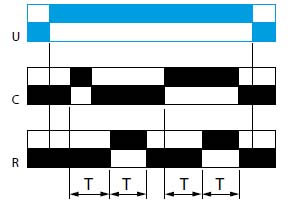
Function Ah
Pulse delayed relay (single cycle) with control signal
After power-up, pulsing or maintaining control contact C starts the timing T. A single cycle then starts with 2 timing periods T of equal duration (start with output in rest position).
Output R changes state at the end of the first timing period T and reverts to its initial position at the end of the second timing period T.
Control contact C must be reset in order to re-start the single flashing cycle.
[Schneider Electric]
Function Ah
Flashing single cycle by switch (not resettable)
After power-up, pressing or holding down the switch starts timing. At the end of timing, the output is energised. At the end of this second timing, the output falls back to its initial value.
[Crouzed]Функция Ah
Задержка импульса при каждой подаче напряжения на управляющий вход
После подачи питания на реле и последующей подачи импульса или постоянно напряжения на управляющий вход С выполняется отсчет паузы длительностью T, а затем такой же длительности импульса. По окончании паузы Т выход реле R замыкается, а по окончании длительности импульса - возвращается в исходное состояние.
Для возобновления такого же цикла формирования одного импульса необходимо вновь подать напряжение на управляющий вход.
[Перевод Интент]
Тематики
EN
Русско-английский словарь нормативно-технической терминологии > функция Ah (реле времени)
-
28 давление
pressure (press, pr)
-, абсолютное (абс.) — absolute pressure
сумма избыточного и бараметрического давлений. давление отсчитываемое от абсалютного нуля. — sum of gage and barometric pressures. pressure above the absolute zero value of pressure.
-, атмосферное — atmospheric pressure
давление в любой точке атмосферы, создаваемое только массой атмосферного воздуха, воздействующей на данную точку. — pressure due solely to the weight of the atmospheric gases above the point conearned.
-, атмосферное (по метеосводке) — reported atmospheric pressure
-, атмосферное, на уровне аэродрома, текущее (при установке барометрической шкалы высотомера) — qfe
-, атмосферное, приведенное к уровню моря (при устаковке барометрической шкалы высотомера) — qnh set the altimeter to actual qnh at transition level.
-, атмосферное, приведенное к уровню моря, местное — local qnh. the change in altimeter setting from 1013 mb to local qnh is made when an approach clearance is issued.
-, атмосферное, приведенное к уровню моря, по метеосводке — forecast qnh (value)
-, атмосферное, приведенное к уровню моря, фактическое — actual onh. compare actual qnh with forecast value and set the altimeter to actual qnh at transition level.
-, атмосферное, стандартное (показание высотомера при установке барометрической шкалы на стандартное давление) — qne
- аэродрома — ground pressure, atmospheric pressure at aerodrome level
-, барометрическое — atmospheric pressure, barometric pressure
- в автомате загрузки — (artificial) feel pressure
- в баке — tank pressure
- в газовоздушном тракте двигателя (с учетом промежуточных давлений перед и за турбинами вд и нд р1....р7 и без учета этих давлений р1... р4) — engine gas flow pressure (p1... р7 or p1... p4)
- в кабине — cabin pressure
- в кабине, абсолютное — absolute cabin pressure
- в кабине, соответствующее высоте... м — cabin pressure altitude of... m
в самолете должно подперживаться давление в кабине, соответствующее высоте не более 15000 фт, при возможном отказе или неисправности системы герметизации кабин. — the airplane must be able to maintain а cabin pressure altitude of not more than 15,000 feet in the event of any reasonably probable failure or malfunction in the pressurization system.
- в камере сгорания — combustion chamber pressure
- в магистрали (линии) — line pressure
- в мб (миллибарах) — pressure in mb (millibars)
- в мм вод. ст. (водяного столба) — pressure in... mm н20
- в мм рт. ст. (ртутного столба) — pressure in mm... hg
- в натяжной камере (высотнаго компенсирующего костюма) — capstan pressure
- в (опорах) вала — bearing pressure
- в пневматиках (колес) — tire (inflation) pressure
- в (нагрудной) пневмокамере (высотного компенсирующего костюма) — (chest) bladder pressure
- в системе — system pressure
- в стояночном тормозе (в системе тормоза) — parking brake pressure
- включения (начала подачи насосом давления в гидросистему) — cut-in pressure
- в критической точке — stagnation /impact/ pressure
давление потока на тело в точке полного торможения потока. — тhe pressure at а stagnation point.
- воздуха за вентилятором компрессора нд — lp compressor fan outlet pressure
- воздуха за компрессором (вд) — (hp) compressor delivery pressure
" возд(уха) на запуск" — start air press(ure)
- воздуха, статическое — static air pressure
- впрыска — injection pressure
- всасывания — suction pressure
- всасывания при откачке топлива из баков (на земле) — defueling suction pressure
-, входное — inlet pressure
давление жидкости (газа), подаваемое в агрегат (напр., насос). — а pressure of liquid (gas) entering the pump.
- выключения (прекращения подачи давления в систему) — cutout pressure
- выключения (сигнализатора давления) — (pressure switch) reset pressure
-, высокое — high pressure (hp)
- выхлопа — exhaust pressure
- выхлопных газов — exhaust pressure
- газов за турбиной — turbine exhaust pressure
- газов за турбиной низкого давления — lp turbine exhaust (total) pressure (p7)
- газов за (поспедней) турбиной, полное — turbine exhaust total pressure (р7)
- газовоздушного тракта двигатепя (с учетом промежуточных давлений перед и за турбинами вд и нд р1... р7) (рис. 48) — engine gas flow pressure (р1... р7)
- газовоздушного тракта двигатепя (без учета промежуточных давлений перед и за турбинами вд и нд р1... р4) (рис. 48) — engine gas flow pressure (p1... р4)
- гидроаккумулятора — accumulator reserved pressure
-, динамическое (q) (скоростной напор) — dynamic pressure (q), impact pressure
давление, создаваемое движущейся жидкостью (газом) и равное 1/2 pv2 — the pressure of a fluid resulting from its motion equal to 1/2 pv2
разность между полным давлением потока и статическим давлением жидкости (газа) в несжимаемом потоке — in incompressible flow dynamic pressure is the difference between total pressure and static pressure.
impact pressure is equal to dynamic pressure in incompressible flow.
-, динамическое (для апределения и обозначения системы пвд, ее приборов, приемников пвд и ппд, трубопроводов и штуцеров, маркируемых буквой "д". — pitot (pressure), "p" the pitot system feeds ram air pressure to the appropriate instruments through the pitot lines. the pitot lines are fitted with pitot selector.
-, динамическое (скоростной напор в сжимаемом потокe, включающий поправку на изменение давления, вызванного влиянием сжимаемости потока) — impact pressure in compressible flow impact pressure include ure change owing to the compressibility effect.
-, динамическое (если имеется в виду полное давление, подаваемое на приемники пвд и ппд) — total /pitot/ pressure
-, динамическое, рабочее (основное) (переключатель) — normal pitot pressure (norm pitot)
-, динамическое, резервное (переключатепь) — auxiliary pitot pressure (aux pitot)
- дня (на аэродроме) — pressure of the day (at the aerodrome level)
-, дополнительное — additional pressure
- за компрессором вд (рз) — hp compressor delivery pressure (p3)
- за компрессором нд (р2) — lp compressor delivery pressure (p2)
- за турбиной (р4 - без учета промежуточных давлений перед и за турбинами вд и нд) — turbine exhaust pressure (p4)
- за турбиной высокого давпения (рз) — hp turbine exhaust pressure (p5)
- за турбиной низкого давления — lp turbine exhaust pressure (р6)
- за турбиной, полное (р7 - с учетом промежуточных давлений перед и за турбинами вд и нд) — turbine exhaust total pressure (р7)
- закрытия клапана — valve-closing pressure
-, зарядное (амортстойки) — inflation pressure
- зарядки гидроаккумулятора, начальное — hydraulic accumulator initial air inflation pressure
-, звуковое — sound pressure
-, избыточное (избыток давления) — excess(ive) pressure
- избыточное (перепад давлений) — pressure differential
-, избыточное (по показанию манометра, ати) — gauge /gage/ pressure
давление, показываемое манометром, сверх атмосфернаго. — pressure indicated by а gauge above atmospheric.
разность между атмосферным и абсолютным давлением по дифференциальному манометру, — the difference between atmospheric pressure and absolute pressures as read from a differential manometer.
-, избыточное (положительный перепад давлений в гермокабине) — positive pressure differential
избыточное давление считается положительным, если давление внутри самолета выше атмосферного. — the pressure differential is positive when the internal pressure is greater than the external.
cabin is pressurized to differential of... kg/cm2.
- измерителя крутящего момента — torque (meter) pressure
-, кабинное — cabin pressure
- "кабины мало" (табло) — low cabin pressure (low cab press)
- колеса на грунт, удельное — wheel tire-ground bearing pressure, specific pressure of the wheel tire on the ground
-, командное (воздушное, топливное) — controlling (air, fuel) pressure
-, конечное — final pressure
-, контактное — contact pressure
-, критическое — critical pressure
-, максимальное рабочее — maximum operating pressure (max oper press)
-, манометрическое (избыточнoe) — gauge /gage/ pressure
-"масла мало" — low oil press(ure)
- масла на входе в двигатель — engine oil inlet pressure (oil-in press)
-, масла, недостаточное — low oil pressure
- на аэродроме (атмосферное) — atmospheric pressure at aerodrome level
- на всасывании (пд с нагнетателем) — manifold pressure
- на входе — inlet pressure
- на входе в воздухозаборник — air intake pressure
- на входе в двигатель (р1) — engine inlet pressure (p1)
- на входе в двигатель, полнoe — engine inlet total pressure (p1)
- на входе в компрессор вд — hp compressor inlet pressure
- на входе в компрессор нд (p1) — lp compressor inlet pressure (p1)
- на входе в насос — pump inlet pressure
- газов на входе в турбину — turbine inlet pressure (р4)
- на входе в турбину вд — hp turbine inlet pressure
- на входе в турбину нд — lp turbine inlet pressure
- на выхлопе — exhaust pressure
- на выходе — outlet pressure
- на выходе из компрессора вд (рз) — hp compressor delivery pressure (рз)
- на выходе из компрессора нд (р2) — lp compressor delivery pressure (р2)
- на выходе из насоса — pump outlet pressure
- на выходе из реактивного сопла — nozzle exit pressure
- на выходе из турбины — turbine exhaust pressure
- на выходе из турбины вд (p5) — hp turbine exhaust pressure (p5)
- на выходе из турбины нд (p6) — lp turbine exhaust pressure (p6)
- на выходе из турбины (турбин вд и нд), полное (р7) — turbine exhaust total pressure (р7)
- (усилие) на ручке управления (или штурвале) в направлении на себя — control stick (or wheel) back pressure
- (усилие) на ручке управления (или штурвале) в направлении от себя — control stick (or wheel) forward pressure
- на срезе реактивного сопла — exhaust nozzle exit pressure
- на уровне аэродрома — (atmospheric) pressure at aerodrome level
- на уровне моря атмосферное давление на среднем уровне моря. — sea-level pressure the atmospheric pressure at mean sea level.
- на уровне (метео) станции (или точки замера) — station pressure. the atmospheric pressure computed for the level of the station elevation.
- нагнетания (насоса) — (pump) outlet pressure
- нагнетания при заправке (топливом) — fueling delivery pressure
- наддува (кабины, баков) — pressurization pressure
- наддува (рк) — manifold pressure (man pres)
давление воздуха (или горючей смеси) на выходе из компрессора (нагнетателя) пд. — pressure delivered by the engine supercharger.
-, начальное — initial pressure
-, неустановившееся — transient pressure
-, низкое (нд) — low pressure (lp)
- нулевой подачи (гидронасоса, работающего через автомат разгрузки). — zero delivery pressure. the stabilized pressure at which the delivery of a variable-delivery hydraulic pump becomes automatically zero.
-, обратное — backpressure
- окружающего воздуха (ро) — ambient pressure (po)
- опрессовки (испытательное) — test pressure
-, осевое — axial pressure
-, остаточное (в системе) — residual pressure
- открытия (клапана) — (valve) opening pressure
-, относительное — relative pressure
-, отрицательное (разрежение) — negative pressure
- перед компрессором нд (p1) — lp compressor inlet pressure (p1)
- перед топливными форсунками (двиг.) — fuel nozzle inlet pressure
- перед турбиной вд и нд (р4) — turbine inlet pressure (р4)
- перекачки (напр. топлива) — transfer pressure
- пневматика (шины) — tire pressure
- пневматика (шины) на грунт, удельное — tire-ground bearing pressure
-, повышенное (за установленный предел) — overpressure, excess(ive) pressure
- подачи — delivery pressure
-, подводимое (к насосу) — (pump) inlet pressure
- полное — total pressure, (full) impact pressure, ram air pressure.
сумма статического и динамического давлений воздушного потока. — sum of static and dynamic pressures.
динамическое давление разность между полным и статическим давлениями. — impact pressure is total pressure less static pressure.
приемник пвд измеряет полное и статическое давление и разность между полным и статическим давлениями используется для измерения скорости потока. — pitot-static tube is used in measuring impact and static pressures. а difference between impact and static pressures is used to measure the flow velocity.
the pitot system feeds ram air pressure to asi.
-, полное (при рассмотрении принципа работы приемников полного и воздушных давлений) — (full) impact pressure the pitot tube end open to the airstream receives the full impact pressure.
-, полное, на входе в двигатель (p1) — engine inlet total pressure (p1) epr is the ratio of turbine
exhaust total pressure (p4) to engine inlet total pressure (p1)
- полного торможения (потока) — total pressure
- по метеосводке (барометрическое) — reported (atmospheric) pressure
-, постоянное — constant pressure
-, предельное — limit pressure
-, предельное (разрушающее) — ultimate pressure
-, рабочее — operating pressure
-, равновесное — equilibrium pressure
- разрушающее (предельное) — ultimate pressure
- разрыва (какого-либо сосуда, работающего под давлением, или авиашины) — bursting pressure
- сжатия — compression pressure
- скоростного напора (q) — dynamic pressure (q) q = pp - ps
- скоростного напора на входе (в двиг.) — ram intake pressure
- срабатывания — actuation pressure
- срабатывания (сигнализатора давления) — operating pressure
-, статическое — static pressure
давление окружающей среды на поверхность в состоянии покоя. — the pressure with respect to а surface at rest in relation to the surrounding fluid.
-, статическое, рабочее (переключатепь) — normal static pressure (norm static)
-, статическое, резервное (переключатель) — auxiliary static pressure (aux static)
- топлива, подаваемое к форсункам — burner pressure (рь)
- торможения (полное, возд. потока) — total pressure total pressure less static pressure is a dynamic pressure.
- торможения (потока) — stagnation pressure
давление в точке торможения потока. — the pressure at a stagnation point.
давление идеального потока. заторможенного без потерь энергии. — the pressure а moving fliud would have if it were brought to rest without losses.
- торможения колес — wheel braking pressure
- торможения колес, располагаемое — pressure available for wheel braking
-, удельное — specific pressure
- управления — control pressure
-, установленное — set pressure
-, установочное (редуктора) — set pressure
- форсажного топлива — afterburner fuel pressure
- щетки (потенциометра) — wiper tension
- щетки (электрической машины) — brush pressure
возрастание д. — pressure rise
диапазон д. — pressure range
диапазон рабочих д. — operating pressure range
зона (область) высокого (барометрического) д. — high-pressure area
зона (область) низкого (барометрического) д. — low-pressure area
испытание д. — pressure test
нарастание д. — pressure rise
перемена д. — change in pressure
перепад д. — pressure differential
повышение д. — increase in pressure
под д. — under pressure
подача (жидкости) под д. — (fluid) delivery /supply/ under pressure
понижение д. — decrease in pressure
потеря д. — pressure loss
при отсутствии д. — at zero pressure
разность д. — pressure differential
распределение д. — pressure distribution
распространение д. — pressure propagation
скачок д. — pressure surge
спад д. — pressure drop
стравливание д. — pressure relief
характер д. — nature of pressure
центр д. — center of pressure
эффект д. — effect of pressure
выдерживать д....кг/см2 — withstand pressure of...kg/sq.cm
выдерживать д. (на апределенном уровне) — maintain pressure
доводить д. до... — build up pressure up to...
наддувать кабину на избыточнoe д.... кг/см2 — pressurize the cabin to a differential of... kg/sq.cm
обеспечивать д. в кабине, соответствующее высоте... м — provide а cabin pressure altitude of... m
отводить (сбрасывать) д. в атмосферу (за борт) — discharge pressure overboard
подавать д. в... — supply /apply, deliver/ pressure to
подавать гидрожидкость под д.... кг/см2 — supply... kg/cm2 hydraulic pressure
подавать (жидкость) под д. — supply (fluid) under pressure, supply (fluid) at the pressure of... kg/cm2
подводить д. к... — apply /supply/ pressure to...
поддерживать д. (на определенном уровне) — maintain pressure
поднимать д. — build up pressure
понижать д. — reduce pressure
прикладывать д. к... — apply pressure to...
сбрасывать д. — relieve pressure
снимать д. — relieve pressure
создавать (задавать) д. (по манометру) — build-up /create/ pressure with reference /referring/ to pressure indicator
стравливать д. — relieve /release/ pressure
стравливать д. в атмосферу (за борт) — release pressure to the atmosphere /overboard/
увеличивать д. — increase pressure
уменьшать д. — decrease pressureРусско-английский сборник авиационно-технических терминов > давление
-
29 скорость
скорость сущ1. speed2. velocity аэродинамика малых скоростейlow-speed aerodynamicsаэродинамическая труба больших скоростейhigh-speed wind tunnelаэродинамическая труба околозвуковых скоростейtransonic wind tunnelбезопасная скоростьsafety speedбезопасная скорость взлетаtakeoff safety speedблок датчиков угловых скоростей гироскопаrate gyro unitблок контроля скорости пробега по землеground run monitorвектор воздушной скоростиairspeed vectorвектор путевой скоростиground speed vectorвертикальная скоростьvertical speedвоздушная скоростьairspeedвосстанавливать скоростьregain the speedвыдерживание скоростиspeed holdingвыдерживать требуемую скорость полетаmaintain the flying speedвычислитель воздушной скоростиair-speed computerгаситель скоростиspeedbrakeгасить посадочную скоростьkill the landing speedгасить скорость в полетеdecelerate in the flightгашение скоростейspeed bleedoffгиперзвуковая скоростьhypersonic speedдатчик воздушной скорости1. airspeed transmitter2. airspeed sensor датчик скоростиvelocity sensorдатчик угловой скорости крена1. roll-rate pickup2. roll rate sensor диапазон больших скоростейhigh-speed rangeдиапазон скоростейspeed rangeдозвуковая скоростьsubsonic speedдопустимая скоростьallowable speedдопустимая эксплуатационная скоростьpermissible operating speedединица скорости телеграфной передачиbaudзадавать определенную скоростьset up the speedзаданная скорость1. target speed2. sufficient speed 3. on-speed замедлять скоростьspeed downзапас скоростиspeed marginзаход на посадку с уменьшением скоростиdecelerating approachзона выдерживания скоростиspeed control areaизмеритель угловой скоростиturnmeterизмеритель угловой скорости кренаrate-of-roll meterиндикаторная воздушная скорость1. calibrate airspeed2. rectified airspeed информация о скоростиrate informationисправленная воздушная скоростьcorrected airspeedисправленная скоростьbasic speed(с учетом погрешности измерения) истинная воздушная скоростьtrue airspeedкомбинированный указатель скоростиcombination airspeed indicatorкоммерческая скоростьblock speedкрейсерская скоростьcruising speedкрейсерская скорость для полета максимальной дальностиlong-range cruise speedкритическая скоростьhump speedлинейная скорость1. linear velocity2. linear speed максимальная скорость порываgust peak speed(воздушной массы) максимально допустимая скорость1. maximum limit speed2. never-exceed speed максимально допустимая скорость прохождения порога ВППmaximum threshold speedмгновенная вертикальная скоростьinstantaneous vertical speed(полета) минимальная безопасная скорость взлетаminimum takeoff safety speedминимальная посадочная скоростьminimum landing speedминимальная скорость отрываminimum unstick speedминимальная скорость полетаminimum flying speedминимально допустимая скорость прохождения порога ВППminimum threshold speedнабирать заданную скорость полетаobtain the flying speedнаименьшая начальная скоростьslowest initial speed(полета) на полной скоростиat full speedнаращивать скоростьgather the speedна скорости1. at a speed of2. on the speed ограничение по скорости полетаair-speed limitationоколозвуковая скорость1. transonic speed2. near-sonic speed окружная скоростьcircumferential speedокружная скорость законцовки воздушного винтаpropeller tip speedокружная скорость лопасти воздушного винтаairscrew blade speedокружная скорость лопатки вентилятораfan tip speedотносительная воздушная скоростьrelative airspeedотносительная скоростьrelative velocityпереходить к скорости набора высотыtransit to the climb speedполет на малой скоростиlow-speed flightполет с уменьшением скоростиdecelerating flightпоправка на воздушную скоростьairspeed compensationпосадочная скоростьlanding speedпоступательная скоростьforward speedпредел скоростей на крейсерском режимеcruising speeds rangeпредел скорости ветраwind limitпредельная скоростьtop speedприборная воздушная скорость1. indicated airspeed2. basic airspeed продольная составляющая скоростиlongitudinal velocityпутевая скорость1. ground speed(скорость воздушного судна относительно земли) 2. ground velocity 3. actual speed равнодействующий вектор скоростиresultant velocity vectorразвивать заданную скорость1. gain the speed2. attain the speed 3. pick up the speed разгонять до скоростиaccelerate to the speedрасчетная воздушная скоростьdesign airspeedрасчетная скоростьdesign speedрасчетная скорость полетаreference flight speedрасчетная скорость сходаexit design speed(с ВПП) регистратор воздушной скоростиair-speed recorderрегулируемая скоростьgoverned speedреле максимальной скоростиspeed warning relayсамопроизвольное восстановление скоростиfree speed returnсверхзвуковая скорость1. supersonic speed2. ultrasonic speed сигнализатор достижения предельной скоростиlimit speed switchсистема привода с постоянной скоростьюconstant speed drive systemсистема управления скоростьюspeed control system(полета) скорость аварийного слива топливаfuel dumping rateскорость балансировкиrate of trimскорость бокового движенияsideward flight speed(вертолета) скорость бокового скольжения1. lateral velocity2. rate of sideslip скорость вертикального порываvertical gust speed(воздушной массы) скорость ветраwind speedскорость ветра у поверхностиsurface wind speed(земли) скорость взлетаtakeoff speedскорость воздушного суднаaircraft speedскорость возникновения бафтингаbuffeting onset speedскорость возникновения флаттераflutter onset speedскорость вращенияrotational speedскорость встречного ветраheadwind speedскорость в условиях турбулентности1. rough airspeed2. rough-air speed скорость выпуска - уборки шассиlanding gear operating speedскорость газового потокаgas flow velocityскорость горизонтального полетаlevel-flight speedскорость движения воздушной массыair velocityскорость, заданная подвижным индексомbug speed(прибора) скорость замедленияdecreasing speedскорость заправки топливных баковfuel tank filling rateскорость затуханияdegeneration speed(звукового удара) скорость захода на посадку1. landing approach speed2. approach speed скорость захода на посадку с убранной механизацией крылаno-flap - no-slat approach speedскорость захода на посадку с убранными закрылкамиno-flap approach speedскорость захода на посадку с убранными предкрылкамиno-slat approach speedскорость звука1. sonic speed2. velocity of sound 3. sound velocity скорость изменения бокового отклоненияcrosstrack distance change rateскорость изменения высотыaltitude rateскорость изменения шага винтаpitch-change rateскорость истечения выхлопных газовexhaust velocityскорость истечения выходящих газов на срезе реактивного соплаnozzle exhaust velocityскорость истечения газовexit velocityскорость кренаrate of rollскорость маневрированияmanoeuvring speedскорость набора высотыascensional rateскорость набора высоты при выходе из зоныclimb-out speedскорость набора высоты при полете по маршрутуen-route climb speedскорость набора высоты с убранными закрылками1. flaps-up climbing speed2. flaps-up climb speed 3. no-flap climb speed скорость на начальном участке набора высоты при взлетеspeed at takeoff climbскорость начала торможенияbrake application speedскорость обгонаovertaking speed(воздушного судна) скорость отклонения закрылковrate of flaps motionскорость отработкиfollow-up rateскорость отрываliftoff speed(при разбеге) скорость отрыва носового колесаrotation speed(при взлете) скорость отрыва при взлетеunstick speedскорость парашютированияsink speed(при посадке) скорость первоначального этапа набора высотыinitial climb speedскорость перед сваливаниемprestall speed(на крыло) скорость пикированияdive speedскорость планированияgliding speedскорость полетаflight speedскорость полета на малом газеflight idle speedскорость попутного ветраtailwind speedскорость порываgust velocityскорость по тангажуrate of pitchскорость прецессииprecession rateскорость при аварийном сниженииemergency descent speedскорость при взлетнойspeed in takeoff configuration(конфигурации воздушного судна) скорость при всех работающих двигателяхall engines speedскорость при выпуске закрылковflaps speedскорость при выпущенных интерцепторахspoiler extended speedскорость при касанииtouchdown speed(ВПП) скорость принятия решенияdecision speed(пилотом) скорость при отказе критического двигателяcritical engine failure speedскорость при полностью убранных закрылкахzero flaps speedскорость при посадочнойspeed in landing configuration(конфигурации воздушного судна) скорость протяжки лентыtape speed(бортового регистратора) скорость прохождения порога ВППthreshold speedскорость разворотаrate of turnскорость раскрытияopening speed(парашюта) скорость рассогласованияrate of disagreementскорость реакцииreaction rateскорость руленияtaxiing speedскорость рысканияrate of yawскорость сближения1. closing speed(воздушных судов) 2. rate of closure скорость сваливанияstalling speed(на крыло) скорость скоса потока внизdownwash velocityскорость слива топливаfuel off-load rateскорость снижения1. descent velocity2. rate of descent скорость снижения перед касаниемsink rateскорость снижения при заходе на посадкуapproach rate of descentскорость сносаdrift rateскорость согласованияslaving rateскорость схода с ВППturnoff speedскорость таможенной пошлиныrate of dutyскорость установившегося полетаsteady flight speedскорость установившегося разворотаsustained turn rateскорость ухода гироскопаgyro drift rateснижать скорость воздушного судна доdecelerate the aircraft toсоставляющая скоростиvelocity componentсредняя скоростьmean speedтаблица поправок воздушной скоростиair-speed calibration cardтарировка указателя воздушной скоростиair-speed indicator calibrationтерять заданную скоростьlose the speedточно выдерживать скоростьhold the speed accuratelyтрафарет ограничения воздушной скоростиairspeed placardтреугольник скоростейtriangle of velocitiesувеличение скоростиspeed increaseувеличивать скоростьincrease the speedугловая скорость1. angular speed2. angular velocity 3. angular rate указатель воздушной скорости1. airspeed indicator2. airspeed instrument указатель индикаторной воздушной скоростиcalibrated airspeed indicatorуказатель путевой скоростиground speed indicatorуказатель скоростиspeed pointerуказатель скорости ветраwind speed indicatorуказатель скорости кренаrate-of-roll indicatorуказатель скорости набора высотыvariometerуказатель скорости разворотаrate-of-turn indicatorуказатель скорости рысканияrate-of-yaw indicatorуказатель скорости снижения на ВППrising runway indicatorуказатель скорости сносаspeed-and-drift meterуказатель сноса и скоростиdrift-speed indicatorуменьшать скоростьdecrease the speedуменьшение скоростиdecelerationуменьшение скорости за счет лобового сопротивленияdeceleration due to dragустановившаяся скорость набора высотыsteady rate of climbустойчивость по скоростиspeed stabilityфактическая воздушная скоростьactual airspeedфактическая скоростьdemonstrated speedфактическая скорость истечения выходящих газовactual exhaust velocityэволютивная скоростьcontrol speedМинимально допустимая скорость при сохранении управляемости. эквивалентная воздушная скоростьequivalent airspeedэкономическая скоростьeconomic speed(при минимальном расходе топлива) эксплуатационная скоростьoperating speedэффект скорости поступательного движенияforward speed effect -
30 исходные данные
1) General subject: bench-mark data, basic data, benchmark data, raw data, feed data2) Computers: input data3) Biology: base line4) Military: base data, opening narrative5) Engineering: initial data, source data6) Mathematics: given data, input data, original observations (эмпирические), s7) Economy: base values, bench marks, initial values, starting data8) Diplomatic term: data base (на переговорах о разоружении)9) Psychology: primary date, reference date10) Telecommunications: initial conditions11) Information technology: master data12) Oil: basis оf design, design premises13) Astronautics: design data, preliminary data, reference data14) Geophysics: prestack data15) Ecology: baseline, baseline data16) Advertising: background, data, original data, original information, primary data17) Business: base value18) Sakhalin energy glossary: background data, basic engineering design data, design basis (для проектирования)19) Quality control: initial value20) Chemical weapons: source (preliminary) data21) Makarov: basic data (исследования), entering wedge, input data (исследования), raw data (исследования)22) Gold mining: (необработанные) raw data23) oil&gas: design premise (для проектирования)24) Combustion gas turbines: initial condition25) Research and development: baseline information -
31 Historical Portugal
Before Romans described western Iberia or Hispania as "Lusitania," ancient Iberians inhabited the land. Phoenician and Greek trading settlements grew up in the Tagus estuary area and nearby coasts. Beginning around 202 BCE, Romans invaded what is today southern Portugal. With Rome's defeat of Carthage, Romans proceeded to conquer and rule the western region north of the Tagus, which they named Roman "Lusitania." In the fourth century CE, as Rome's rule weakened, the area experienced yet another invasion—Germanic tribes, principally the Suevi, who eventually were Christianized. During the sixth century CE, the Suevi kingdom was superseded by yet another Germanic tribe—the Christian Visigoths.A major turning point in Portugal's history came in 711, as Muslim armies from North Africa, consisting of both Arab and Berber elements, invaded the Iberian Peninsula from across the Straits of Gibraltar. They entered what is now Portugal in 714, and proceeded to conquer most of the country except for the far north. For the next half a millennium, Islam and Muslim presence in Portugal left a significant mark upon the politics, government, language, and culture of the country.Islam, Reconquest, and Portugal Created, 714-1140The long frontier struggle between Muslim invaders and Christian communities in the north of the Iberian peninsula was called the Reconquista (Reconquest). It was during this struggle that the first dynasty of Portuguese kings (Burgundian) emerged and the independent monarchy of Portugal was established. Christian forces moved south from what is now the extreme north of Portugal and gradually defeated Muslim forces, besieging and capturing towns under Muslim sway. In the ninth century, as Christian forces slowly made their way southward, Christian elements were dominant only in the area between Minho province and the Douro River; this region became known as "territorium Portu-calense."In the 11th century, the advance of the Reconquest quickened as local Christian armies were reinforced by crusading knights from what is now France and England. Christian forces took Montemor (1034), at the Mondego River; Lamego (1058); Viseu (1058); and Coimbra (1064). In 1095, the king of Castile and Léon granted the country of "Portu-cale," what became northern Portugal, to a Burgundian count who had emigrated from France. This was the foundation of Portugal. In 1139, a descendant of this count, Afonso Henriques, proclaimed himself "King of Portugal." He was Portugal's first monarch, the "Founder," and the first of the Burgundian dynasty, which ruled until 1385.The emergence of Portugal in the 12th century as a separate monarchy in Iberia occurred before the Christian Reconquest of the peninsula. In the 1140s, the pope in Rome recognized Afonso Henriques as king of Portugal. In 1147, after a long, bloody siege, Muslim-occupied Lisbon fell to Afonso Henriques's army. Lisbon was the greatest prize of the 500-year war. Assisting this effort were English crusaders on their way to the Holy Land; the first bishop of Lisbon was an Englishman. When the Portuguese captured Faro and Silves in the Algarve province in 1248-50, the Reconquest of the extreme western portion of the Iberian peninsula was complete—significantly, more than two centuries before the Spanish crown completed the Reconquest of the eastern portion by capturing Granada in 1492.Consolidation and Independence of Burgundian Portugal, 1140-1385Two main themes of Portugal's early existence as a monarchy are the consolidation of control over the realm and the defeat of a Castil-ian threat from the east to its independence. At the end of this period came the birth of a new royal dynasty (Aviz), which prepared to carry the Christian Reconquest beyond continental Portugal across the straits of Gibraltar to North Africa. There was a variety of motives behind these developments. Portugal's independent existence was imperiled by threats from neighboring Iberian kingdoms to the north and east. Politics were dominated not only by efforts against the Muslims inPortugal (until 1250) and in nearby southern Spain (until 1492), but also by internecine warfare among the kingdoms of Castile, Léon, Aragon, and Portugal. A final comeback of Muslim forces was defeated at the battle of Salado (1340) by allied Castilian and Portuguese forces. In the emerging Kingdom of Portugal, the monarch gradually gained power over and neutralized the nobility and the Church.The historic and commonplace Portuguese saying "From Spain, neither a good wind nor a good marriage" was literally played out in diplomacy and war in the late 14th-century struggles for mastery in the peninsula. Larger, more populous Castile was pitted against smaller Portugal. Castile's Juan I intended to force a union between Castile and Portugal during this era of confusion and conflict. In late 1383, Portugal's King Fernando, the last king of the Burgundian dynasty, suddenly died prematurely at age 38, and the Master of Aviz, Portugal's most powerful nobleman, took up the cause of independence and resistance against Castile's invasion. The Master of Aviz, who became King João I of Portugal, was able to obtain foreign assistance. With the aid of English archers, Joao's armies defeated the Castilians in the crucial battle of Aljubarrota, on 14 August 1385, a victory that assured the independence of the Portuguese monarchy from its Castilian nemesis for several centuries.Aviz Dynasty and Portugal's First Overseas Empire, 1385-1580The results of the victory at Aljubarrota, much celebrated in Portugal's art and monuments, and the rise of the Aviz dynasty also helped to establish a new merchant class in Lisbon and Oporto, Portugal's second city. This group supported King João I's program of carrying the Reconquest to North Africa, since it was interested in expanding Portugal's foreign commerce and tapping into Muslim trade routes and resources in Africa. With the Reconquest against the Muslims completed in Portugal and the threat from Castile thwarted for the moment, the Aviz dynasty launched an era of overseas conquest, exploration, and trade. These efforts dominated Portugal's 15th and 16th centuries.The overseas empire and age of Discoveries began with Portugal's bold conquest in 1415 of the Moroccan city of Ceuta. One royal member of the 1415 expedition was young, 21-year-old Prince Henry, later known in history as "Prince Henry the Navigator." His part in the capture of Ceuta won Henry his knighthood and began Portugal's "Marvelous Century," during which the small kingdom was counted as a European and world power of consequence. Henry was the son of King João I and his English queen, Philippa of Lancaster, but he did not inherit the throne. Instead, he spent most of his life and his fortune, and that of the wealthy military Order of Christ, on various imperial ventures and on voyages of exploration down the African coast and into the Atlantic. While mythology has surrounded Henry's controversial role in the Discoveries, and this role has been exaggerated, there is no doubt that he played a vital part in the initiation of Portugal's first overseas empire and in encouraging exploration. He was naturally curious, had a sense of mission for Portugal, and was a strong leader. He also had wealth to expend; at least a third of the African voyages of the time were under his sponsorship. If Prince Henry himself knew little science, significant scientific advances in navigation were made in his day.What were Portugal's motives for this new imperial effort? The well-worn historical cliche of "God, Glory, and Gold" can only partly explain the motivation of a small kingdom with few natural resources and barely 1 million people, which was greatly outnumbered by the other powers it confronted. Among Portuguese objectives were the desire to exploit known North African trade routes and resources (gold, wheat, leather, weaponry, and other goods that were scarce in Iberia); the need to outflank the Muslim world in the Mediterranean by sailing around Africa, attacking Muslims en route; and the wish to ally with Christian kingdoms beyond Africa. This enterprise also involved a strategy of breaking the Venetian spice monopoly by trading directly with the East by means of discovering and exploiting a sea route around Africa to Asia. Besides the commercial motives, Portugal nurtured a strong crusading sense of Christian mission, and various classes in the kingdom saw an opportunity for fame and gain.By the time of Prince Henry's death in 1460, Portugal had gained control of the Atlantic archipelagos of the Azores and Madeiras, begun to colonize the Cape Verde Islands, failed to conquer the Canary Islands from Castile, captured various cities on Morocco's coast, and explored as far as Senegal, West Africa, down the African coast. By 1488, Bar-tolomeu Dias had rounded the Cape of Good Hope in South Africa and thereby discovered the way to the Indian Ocean.Portugal's largely coastal African empire and later its fragile Asian empire brought unexpected wealth but were purchased at a high price. Costs included wars of conquest and defense against rival powers, manning the far-flung navel and trade fleets and scattered castle-fortresses, and staffing its small but fierce armies, all of which entailed a loss of skills and population to maintain a scattered empire. Always short of capital, the monarchy became indebted to bankers. There were many defeats beginning in the 16th century at the hands of the larger imperial European monarchies (Spain, France, England, and Holland) and many attacks on Portugal and its strung-out empire. Typically, there was also the conflict that arose when a tenuously held world empire that rarely if ever paid its way demanded finance and manpower Portugal itself lacked.The first 80 years of the glorious imperial era, the golden age of Portugal's imperial power and world influence, was an African phase. During 1415-88, Portuguese navigators and explorers in small ships, some of them caravelas (caravels), explored the treacherous, disease-ridden coasts of Africa from Morocco to South Africa beyond the Cape of Good Hope. By the 1470s, the Portuguese had reached the Gulf of Guinea and, in the early 1480s, what is now Angola. Bartolomeu Dias's extraordinary voyage of 1487-88 to South Africa's coast and the edge of the Indian Ocean convinced Portugal that the best route to Asia's spices and Christians lay south, around the tip of southern Africa. Between 1488 and 1495, there was a hiatus caused in part by domestic conflict in Portugal, discussion of resources available for further conquests beyond Africa in Asia, and serious questions as to Portugal's capacity to reach beyond Africa. In 1495, King Manuel and his council decided to strike for Asia, whatever the consequences. In 1497-99, Vasco da Gama, under royal orders, made the epic two-year voyage that discovered the sea route to western India (Asia), outflanked Islam and Venice, and began Portugal's Asian empire. Within 50 years, Portugal had discovered and begun the exploitation of its largest colony, Brazil, and set up forts and trading posts from the Middle East (Aden and Ormuz), India (Calicut, Goa, etc.), Malacca, and Indonesia to Macau in China.By the 1550s, parts of its largely coastal, maritime trading post empire from Morocco to the Moluccas were under siege from various hostile forces, including Muslims, Christians, and Hindi. Although Moroccan forces expelled the Portuguese from the major coastal cities by 1550, the rival European monarchies of Castile (Spain), England, France, and later Holland began to seize portions of her undermanned, outgunned maritime empire.In 1580, Phillip II of Spain, whose mother was a Portuguese princess and who had a strong claim to the Portuguese throne, invaded Portugal, claimed the throne, and assumed control over the realm and, by extension, its African, Asian, and American empires. Phillip II filled the power vacuum that appeared in Portugal following the loss of most of Portugal's army and its young, headstrong King Sebastião in a disastrous war in Morocco. Sebastiao's death in battle (1578) and the lack of a natural heir to succeed him, as well as the weak leadership of the cardinal who briefly assumed control in Lisbon, led to a crisis that Spain's strong monarch exploited. As a result, Portugal lost its independence to Spain for a period of 60 years.Portugal under Spanish Rule, 1580-1640Despite the disastrous nature of Portugal's experience under Spanish rule, "The Babylonian Captivity" gave birth to modern Portuguese nationalism, its second overseas empire, and its modern alliance system with England. Although Spain allowed Portugal's weakened empire some autonomy, Spanish rule in Portugal became increasingly burdensome and unacceptable. Spain's ambitious imperial efforts in Europe and overseas had an impact on the Portuguese as Spain made greater and greater demands on its smaller neighbor for manpower and money. Portugal's culture underwent a controversial Castilianization, while its empire became hostage to Spain's fortunes. New rival powers England, France, and Holland attacked and took parts of Spain's empire and at the same time attacked Portugal's empire, as well as the mother country.Portugal's empire bore the consequences of being attacked by Spain's bitter enemies in what was a form of world war. Portuguese losses were heavy. By 1640, Portugal had lost most of its Moroccan cities as well as Ceylon, the Moluccas, and sections of India. With this, Portugal's Asian empire was gravely weakened. Only Goa, Damão, Diu, Bombay, Timor, and Macau remained and, in Brazil, Dutch forces occupied the northeast.On 1 December 1640, long commemorated as a national holiday, Portuguese rebels led by the duke of Braganza overthrew Spanish domination and took advantage of Spanish weakness following a more serious rebellion in Catalonia. Portugal regained independence from Spain, but at a price: dependence on foreign assistance to maintain its independence in the form of the renewal of the alliance with England.Restoration and Second Empire, 1640-1822Foreign affairs and empire dominated the restoration era and aftermath, and Portugal again briefly enjoyed greater European power and prestige. The Anglo-Portuguese Alliance was renewed and strengthened in treaties of 1642, 1654, and 1661, and Portugal's independence from Spain was underwritten by English pledges and armed assistance. In a Luso-Spanish treaty of 1668, Spain recognized Portugal's independence. Portugal's alliance with England was a marriage of convenience and necessity between two monarchies with important religious, cultural, and social differences. In return for legal, diplomatic, and trade privileges, as well as the use during war and peace of Portugal's great Lisbon harbor and colonial ports for England's navy, England pledged to protect Portugal and its scattered empire from any attack. The previously cited 17th-century alliance treaties were renewed later in the Treaty of Windsor, signed in London in 1899. On at least 10 different occasions after 1640, and during the next two centuries, England was central in helping prevent or repel foreign invasions of its ally, Portugal.Portugal's second empire (1640-1822) was largely Brazil-oriented. Portuguese colonization, exploitation of wealth, and emigration focused on Portuguese America, and imperial revenues came chiefly from Brazil. Between 1670 and 1740, Portugal's royalty and nobility grew wealthier on funds derived from Brazilian gold, diamonds, sugar, tobacco, and other crops, an enterprise supported by the Atlantic slave trade and the supply of African slave labor from West Africa and Angola. Visitors today can see where much of that wealth was invested: Portugal's rich legacy of monumental architecture. Meanwhile, the African slave trade took a toll in Angola and West Africa.In continental Portugal, absolutist monarchy dominated politics and government, and there was a struggle for position and power between the monarchy and other institutions, such as the Church and nobility. King José I's chief minister, usually known in history as the marquis of Pombal (ruled 1750-77), sharply suppressed the nobility and theChurch (including the Inquisition, now a weak institution) and expelled the Jesuits. Pombal also made an effort to reduce economic dependence on England, Portugal's oldest ally. But his successes did not last much beyond his disputed time in office.Beginning in the late 18th century, the European-wide impact of the French Revolution and the rise of Napoleon placed Portugal in a vulnerable position. With the monarchy ineffectively led by an insane queen (Maria I) and her indecisive regent son (João VI), Portugal again became the focus of foreign ambition and aggression. With England unable to provide decisive assistance in time, France—with Spain's consent—invaded Portugal in 1807. As Napoleon's army under General Junot entered Lisbon meeting no resistance, Portugal's royal family fled on a British fleet to Brazil, where it remained in exile until 1821. In the meantime, Portugal's overseas empire was again under threat. There was a power vacuum as the monarch was absent, foreign armies were present, and new political notions of liberalism and constitutional monarchy were exciting various groups of citizens.Again England came to the rescue, this time in the form of the armies of the duke of Wellington. Three successive French invasions of Portugal were defeated and expelled, and Wellington succeeded in carrying the war against Napoleon across the Portuguese frontier into Spain. The presence of the English army, the new French-born liberal ideas, and the political vacuum combined to create revolutionary conditions. The French invasions and the peninsular wars, where Portuguese armed forces played a key role, marked the beginning of a new era in politics.Liberalism and Constitutional Monarchy, 1822-1910During 1807-22, foreign invasions, war, and civil strife over conflicting political ideas gravely damaged Portugal's commerce, economy, and novice industry. The next terrible blow was the loss of Brazil in 1822, the jewel in the imperial crown. Portugal's very independence seemed to be at risk. In vain, Portugal sought to resist Brazilian independence by force, but in 1825 it formally acknowledged Brazilian independence by treaty.Portugal's slow recovery from the destructive French invasions and the "war of independence" was complicated by civil strife over the form of constitutional monarchy that best suited Portugal. After struggles over these issues between 1820 and 1834, Portugal settled somewhat uncertainly into a moderate constitutional monarchy whose constitution (Charter of 1826) lent it strong political powers to exert a moderating influence between the executive and legislative branches of the government. It also featured a new upper middle class based on land ownership and commerce; a Catholic Church that, although still important, lived with reduced privileges and property; a largely African (third) empire to which Lisbon and Oporto devoted increasing spiritual and material resources, starting with the liberal imperial plans of 1836 and 1851, and continuing with the work of institutions like the Lisbon Society of Geography (established 1875); and a mass of rural peasants whose bonds to the land weakened after 1850 and who began to immigrate in increasing numbers to Brazil and North America.Chronic military intervention in national politics began in 19th-century Portugal. Such intervention, usually commencing with coups or pronunciamentos (military revolts), was a shortcut to the spoils of political office and could reflect popular discontent as well as the power of personalities. An early example of this was the 1817 golpe (coup) attempt of General Gomes Freire against British military rule in Portugal before the return of King João VI from Brazil. Except for a more stable period from 1851 to 1880, military intervention in politics, or the threat thereof, became a feature of the constitutional monarchy's political life, and it continued into the First Republic and the subsequent Estado Novo.Beginning with the Regeneration period (1851-80), Portugal experienced greater political stability and economic progress. Military intervention in politics virtually ceased; industrialization and construction of railroads, roads, and bridges proceeded; two political parties (Regenerators and Historicals) worked out a system of rotation in power; and leading intellectuals sparked a cultural revival in several fields. In 19th-century literature, there was a new golden age led by such figures as Alexandre Herculano (historian), Eça de Queirós (novelist), Almeida Garrett (playwright and essayist), Antero de Quental (poet), and Joaquim Oliveira Martins (historian and social scientist). In its third overseas empire, Portugal attempted to replace the slave trade and slavery with legitimate economic activities; to reform the administration; and to expand Portuguese holdings beyond coastal footholds deep into the African hinterlands in West, West Central, and East Africa. After 1841, to some extent, and especially after 1870, colonial affairs, combined with intense nationalism, pressures for economic profit in Africa, sentiment for national revival, and the drift of European affairs would make or break Lisbon governments.Beginning with the political crisis that arose out of the "English Ultimatum" affair of January 1890, the monarchy became discredtted and identified with the poorly functioning government, political parties splintered, and republicanism found more supporters. Portugal participated in the "Scramble for Africa," expanding its African holdings, but failed to annex territory connecting Angola and Mozambique. A growing foreign debt and state bankruptcy as of the early 1890s damaged the constitutional monarchy's reputation, despite the efforts of King Carlos in diplomacy, the renewal of the alliance in the Windsor Treaty of 1899, and the successful if bloody colonial wars in the empire (1880-97). Republicanism proclaimed that Portugal's weak economy and poor society were due to two historic institutions: the monarchy and the Catholic Church. A republic, its stalwarts claimed, would bring greater individual liberty; efficient, if more decentralized government; and a stronger colonial program while stripping the Church of its role in both society and education.As the monarchy lost support and republicans became more aggressive, violence increased in politics. King Carlos I and his heir Luís were murdered in Lisbon by anarchist-republicans on 1 February 1908. Following a military and civil insurrection and fighting between monarchist and republican forces, on 5 October 1910, King Manuel II fled Portugal and a republic was proclaimed.First Parliamentary Republic, 1910-26Portugal's first attempt at republican government was the most unstable, turbulent parliamentary republic in the history of 20th-century Western Europe. During a little under 16 years of the republic, there were 45 governments, a number of legislatures that did not complete normal terms, military coups, and only one president who completed his four-year term in office. Portuguese society was poorly prepared for this political experiment. Among the deadly legacies of the monarchy were a huge public debt; a largely rural, apolitical, and illiterate peasant population; conflict over the causes of the country's misfortunes; and lack of experience with a pluralist, democratic system.The republic had some talented leadership but lacked popular, institutional, and economic support. The 1911 republican constitution established only a limited democracy, as only a small portion of the adult male citizenry was eligible to vote. In a country where the majority was Catholic, the republic passed harshly anticlerical laws, and its institutions and supporters persecuted both the Church and its adherents. During its brief disjointed life, the First Republic drafted important reform plans in economic, social, and educational affairs; actively promoted development in the empire; and pursued a liberal, generous foreign policy. Following British requests for Portugal's assistance in World War I, Portugal entered the war on the Allied side in March 1916 and sent armies to Flanders and Portuguese Africa. Portugal's intervention in that conflict, however, was too costly in many respects, and the ultimate failure of the republic in part may be ascribed to Portugal's World War I activities.Unfortunately for the republic, its time coincided with new threats to Portugal's African possessions: World War I, social and political demands from various classes that could not be reconciled, excessive military intervention in politics, and, in particular, the worst economic and financial crisis Portugal had experienced since the 16th and 17th centuries. After the original Portuguese Republican Party (PRP, also known as the "Democrats") splintered into three warring groups in 1912, no true multiparty system emerged. The Democrats, except for only one or two elections, held an iron monopoly of electoral power, and political corruption became a major issue. As extreme right-wing dictatorships elsewhere in Europe began to take power in Italy (1922), neighboring Spain (1923), and Greece (1925), what scant popular support remained for the republic collapsed. Backed by a right-wing coalition of landowners from Alentejo, clergy, Coimbra University faculty and students, Catholic organizations, and big business, career military officers led by General Gomes da Costa executed a coup on 28 May 1926, turned out the last republican government, and established a military government.The Estado Novo (New State), 1926-74During the military phase (1926-32) of the Estado Novo, professional military officers, largely from the army, governed and administered Portugal and held key cabinet posts, but soon discovered that the military possessed no magic formula that could readily solve the problems inherited from the First Republic. Especially during the years 1926-31, the military dictatorship, even with its political repression of republican activities and institutions (military censorship of the press, political police action, and closure of the republic's rowdy parliament), was characterized by similar weaknesses: personalism and factionalism; military coups and political instability, including civil strife and loss of life; state debt and bankruptcy; and a weak economy. "Barracks parliamentarism" was not an acceptable alternative even to the "Nightmare Republic."Led by General Óscar Carmona, who had replaced and sent into exile General Gomes da Costa, the military dictatorship turned to a civilian expert in finance and economics to break the budget impasse and bring coherence to the disorganized system. Appointed minister of finance on 27 April 1928, the Coimbra University Law School professor of economics Antônio de Oliveira Salazar (1889-1970) first reformed finance, helped balance the budget, and then turned to other concerns as he garnered extraordinary governing powers. In 1930, he was appointed interim head of another key ministry (Colonies) and within a few years had become, in effect, a civilian dictator who, with the military hierarchy's support, provided the government with coherence, a program, and a set of policies.For nearly 40 years after he was appointed the first civilian prime minister in 1932, Salazar's personality dominated the government. Unlike extreme right-wing dictators elsewhere in Europe, Salazar was directly appointed by the army but was never endorsed by a popular political party, street militia, or voter base. The scholarly, reclusive former Coimbra University professor built up what became known after 1932 as the Estado Novo ("New State"), which at the time of its overthrow by another military coup in 1974, was the longest surviving authoritarian regime in Western Europe. The system of Salazar and the largely academic and technocratic ruling group he gathered in his cabinets was based on the central bureaucracy of the state, which was supported by the president of the republic—always a senior career military officer, General Óscar Carmona (1928-51), General Craveiro Lopes (1951-58), and Admiral Américo Tómaz (1958-74)—and the complicity of various institutions. These included a rubber-stamp legislature called the National Assembly (1935-74) and a political police known under various names: PVDE (1932-45), PIDE (1945-69),and DGS (1969-74). Other defenders of the Estado Novo security were paramilitary organizations such as the National Republican Guard (GNR); the Portuguese Legion (PL); and the Portuguese Youth [Movement]. In addition to censorship of the media, theater, and books, there was political repression and a deliberate policy of depoliticization. All political parties except for the approved movement of regime loyalists, the União Nacional or (National Union), were banned.The most vigorous and more popular period of the New State was 1932-44, when the basic structures were established. Never monolithic or entirely the work of one person (Salazar), the New State was constructed with the assistance of several dozen top associates who were mainly academics from law schools, some technocrats with specialized skills, and a handful of trusted career military officers. The 1933 Constitution declared Portugal to be a "unitary, corporative Republic," and pressures to restore the monarchy were resisted. Although some of the regime's followers were fascists and pseudofascists, many more were conservative Catholics, integralists, nationalists, and monarchists of different varieties, and even some reactionary republicans. If the New State was authoritarian, it was not totalitarian and, unlike fascism in Benito Mussolini's Italy or Adolf Hitler's Germany, it usually employed the minimum of violence necessary to defeat what remained a largely fractious, incoherent opposition.With the tumultuous Second Republic and the subsequent civil war in nearby Spain, the regime felt threatened and reinforced its defenses. During what Salazar rightly perceived as a time of foreign policy crisis for Portugal (1936-45), he assumed control of the Ministry of Foreign Affairs. From there, he pursued four basic foreign policy objectives: supporting the Nationalist rebels of General Francisco Franco in the Spanish Civil War (1936-39) and concluding defense treaties with a triumphant Franco; ensuring that General Franco in an exhausted Spain did not enter World War II on the Axis side; maintaining Portuguese neutrality in World War II with a post-1942 tilt toward the Allies, including granting Britain and the United States use of bases in the Azores Islands; and preserving and protecting Portugal's Atlantic Islands and its extensive, if poor, overseas empire in Africa and Asia.During the middle years of the New State (1944-58), many key Salazar associates in government either died or resigned, and there was greater social unrest in the form of unprecedented strikes and clandestine Communist activities, intensified opposition, and new threatening international pressures on Portugal's overseas empire. During the earlier phase of the Cold War (1947-60), Portugal became a steadfast, if weak, member of the US-dominated North Atlantic Treaty Organization alliance and, in 1955, with American support, Portugal joined the United Nations (UN). Colonial affairs remained a central concern of the regime. As of 1939, Portugal was the third largest colonial power in the world and possessed territories in tropical Africa (Angola, Mozambique, Guinea-Bissau, and São Tomé and Príncipe Islands) and the remnants of its 16th-century empire in Asia (Goa, Damão, Diu, East Timor, and Macau). Beginning in the early 1950s, following the independence of India in 1947, Portugal resisted Indian pressures to decolonize Portuguese India and used police forces to discourage internal opposition in its Asian and African colonies.The later years of the New State (1958-68) witnessed the aging of the increasingly isolated but feared Salazar and new threats both at home and overseas. Although the regime easily overcame the brief oppositionist threat from rival presidential candidate General Humberto Delgado in the spring of 1958, new developments in the African and Asian empires imperiled the authoritarian system. In February 1961, oppositionists hijacked the Portuguese ocean liner Santa Maria and, in following weeks, African insurgents in northern Angola, although they failed to expel the Portuguese, gained worldwide media attention, discredited the New State, and began the 13-year colonial war. After thwarting a dissident military coup against his continued leadership, Salazar and his ruling group mobilized military repression in Angola and attempted to develop the African colonies at a faster pace in order to ensure Portuguese control. Meanwhile, the other European colonial powers (Britain, France, Belgium, and Spain) rapidly granted political independence to their African territories.At the time of Salazar's removal from power in September 1968, following a stroke, Portugal's efforts to maintain control over its colonies appeared to be successful. President Americo Tomás appointed Dr. Marcello Caetano as Salazar's successor as prime minister. While maintaining the New State's basic structures, and continuing the regime's essential colonial policy, Caetano attempted wider reforms in colonial administration and some devolution of power from Lisbon, as well as more freedom of expression in Lisbon. Still, a great deal of the budget was devoted to supporting the wars against the insurgencies in Africa. Meanwhile in Asia, Portuguese India had fallen when the Indian army invaded in December 1961. The loss of Goa was a psychological blow to the leadership of the New State, and of the Asian empire only East Timor and Macau remained.The Caetano years (1968-74) were but a hiatus between the waning Salazar era and a new regime. There was greater political freedom and rapid economic growth (5-6 percent annually to late 1973), but Caetano's government was unable to reform the old system thoroughly and refused to consider new methods either at home or in the empire. In the end, regime change came from junior officers of the professional military who organized the Armed Forces Movement (MFA) against the Caetano government. It was this group of several hundred officers, mainly in the army and navy, which engineered a largely bloodless coup in Lisbon on 25 April 1974. Their unexpected action brought down the 48-year-old New State and made possible the eventual establishment and consolidation of democratic governance in Portugal, as well as a reorientation of the country away from the Atlantic toward Europe.Revolution of Carnations, 1974-76Following successful military operations of the Armed Forces Movement against the Caetano government, Portugal experienced what became known as the "Revolution of Carnations." It so happened that during the rainy week of the military golpe, Lisbon flower shops were featuring carnations, and the revolutionaries and their supporters adopted the red carnation as the common symbol of the event, as well as of the new freedom from dictatorship. The MFA, whose leaders at first were mostly little-known majors and captains, proclaimed a three-fold program of change for the new Portugal: democracy; decolonization of the overseas empire, after ending the colonial wars; and developing a backward economy in the spirit of opportunity and equality. During the first 24 months after the coup, there was civil strife, some anarchy, and a power struggle. With the passing of the Estado Novo, public euphoria burst forth as the new provisional military government proclaimed the freedoms of speech, press, and assembly, and abolished censorship, the political police, the Portuguese Legion, Portuguese Youth, and other New State organizations, including the National Union. Scores of political parties were born and joined the senior political party, the Portuguese Community Party (PCP), and the Socialist Party (PS), founded shortly before the coup.Portugal's Revolution of Carnations went through several phases. There was an attempt to take control by radical leftists, including the PCP and its allies. This was thwarted by moderate officers in the army, as well as by the efforts of two political parties: the PS and the Social Democrats (PPD, later PSD). The first phase was from April to September 1974. Provisional president General Antonio Spínola, whose 1974 book Portugal and the Future had helped prepare public opinion for the coup, met irresistible leftist pressures. After Spinola's efforts to avoid rapid decolonization of the African empire failed, he resigned in September 1974. During the second phase, from September 1974 to March 1975, radical military officers gained control, but a coup attempt by General Spínola and his supporters in Lisbon in March 1975 failed and Spínola fled to Spain.In the third phase of the Revolution, March-November 1975, a strong leftist reaction followed. Farm workers occupied and "nationalized" 1.1 million hectares of farmland in the Alentejo province, and radical military officers in the provisional government ordered the nationalization of Portuguese banks (foreign banks were exempted), utilities, and major industries, or about 60 percent of the economic system. There were power struggles among various political parties — a total of 50 emerged—and in the streets there was civil strife among labor, military, and law enforcement groups. A constituent assembly, elected on 25 April 1975, in Portugal's first free elections since 1926, drafted a democratic constitution. The Council of the Revolution (CR), briefly a revolutionary military watchdog committee, was entrenched as part of the government under the constitution, until a later revision. During the chaotic year of 1975, about 30 persons were killed in political frays while unstable provisional governments came and went. On 25 November 1975, moderate military forces led by Colonel Ramalho Eanes, who later was twice elected president of the republic (1976 and 1981), defeated radical, leftist military groups' revolutionary conspiracies.In the meantime, Portugal's scattered overseas empire experienced a precipitous and unprepared decolonization. One by one, the former colonies were granted and accepted independence—Guinea-Bissau (September 1974), Cape Verde Islands (July 1975), and Mozambique (July 1975). Portugal offered to turn over Macau to the People's Republic of China, but the offer was refused then and later negotiations led to the establishment of a formal decolonization or hand-over date of 1999. But in two former colonies, the process of decolonization had tragic results.In Angola, decolonization negotiations were greatly complicated by the fact that there were three rival nationalist movements in a struggle for power. The January 1975 Alvor Agreement signed by Portugal and these three parties was not effectively implemented. A bloody civil war broke out in Angola in the spring of 1975 and, when Portuguese armed forces withdrew and declared that Angola was independent on 11 November 1975, the bloodshed only increased. Meanwhile, most of the white Portuguese settlers from Angola and Mozambique fled during the course of 1975. Together with African refugees, more than 600,000 of these retornados ("returned ones") went by ship and air to Portugal and thousands more to Namibia, South Africa, Brazil, Canada, and the United States.The second major decolonization disaster was in Portugal's colony of East Timor in the Indonesian archipelago. Portugal's capacity to supervise and control a peaceful transition to independence in this isolated, neglected colony was limited by the strength of giant Indonesia, distance from Lisbon, and Portugal's revolutionary disorder and inability to defend Timor. In early December 1975, before Portugal granted formal independence and as one party, FRETILIN, unilaterally declared East Timor's independence, Indonesia's armed forces invaded, conquered, and annexed East Timor. Indonesian occupation encountered East Timorese resistance, and a heavy loss of life followed. The East Timor question remained a contentious international issue in the UN, as well as in Lisbon and Jakarta, for more than 20 years following Indonesia's invasion and annexation of the former colony of Portugal. Major changes occurred, beginning in 1998, after Indonesia underwent a political revolution and allowed a referendum in East Timor to decide that territory's political future in August 1999. Most East Timorese chose independence, but Indonesian forces resisted that verdict untilUN intervention in September 1999. Following UN rule for several years, East Timor attained full independence on 20 May 2002.Consolidation of Democracy, 1976-2000After several free elections and record voter turnouts between 25 April 1975 and June 1976, civil war was averted and Portugal's second democratic republic began to stabilize. The MFA was dissolved, the military were returned to the barracks, and increasingly elected civilians took over the government of the country. The 1976 Constitution was revised several times beginning in 1982 and 1989, in order to reempha-size the principle of free enterprise in the economy while much of the large, nationalized sector was privatized. In June 1976, General Ram-alho Eanes was elected the first constitutional president of the republic (five-year term), and he appointed socialist leader Dr. Mário Soares as prime minister of the first constitutional government.From 1976 to 1985, Portugal's new system featured a weak economy and finances, labor unrest, and administrative and political instability. The difficult consolidation of democratic governance was eased in part by the strong currency and gold reserves inherited from the Estado Novo, but Lisbon seemed unable to cope with high unemployment, new debt, the complex impact of the refugees from Africa, world recession, and the agitation of political parties. Four major parties emerged from the maelstrom of 1974-75, except for the Communist Party, all newly founded. They were, from left to right, the Communists (PCP); the Socialists (PS), who managed to dominate governments and the legislature but not win a majority in the Assembly of the Republic; the Social Democrats (PSD); and the Christian Democrats (CDS). During this period, the annual growth rate was low (l-2 percent), and the nationalized sector of the economy stagnated.Enhanced economic growth, greater political stability, and more effective central government as of 1985, and especially 1987, were due to several developments. In 1977, Portugal applied for membership in the European Economic Community (EEC), now the European Union (EU) since 1993. In January 1986, with Spain, Portugal was granted membership, and economic and financial progress in the intervening years has been significantly influenced by the comparatively large investment, loans, technology, advice, and other assistance from the EEC. Low unemployment, high annual growth rates (5 percent), and moderate inflation have also been induced by the new political and administrative stability in Lisbon. Led by Prime Minister Cavaco Silva, an economist who was trained abroad, the PSD's strong organization, management, and electoral support since 1985 have assisted in encouraging economic recovery and development. In 1985, the PSD turned the PS out of office and won the general election, although they did not have an absolute majority of assembly seats. In 1986, Mário Soares was elected president of the republic, the first civilian to hold that office since the First Republic. In the elections of 1987 and 1991, however, the PSD was returned to power with clear majorities of over 50 percent of the vote.Although the PSD received 50.4 percent of the vote in the 1991 parliamentary elections and held a 42-seat majority in the Assembly of the Republic, the party began to lose public support following media revelations regarding corruption and complaints about Prime Minister Cavaco Silva's perceived arrogant leadership style. President Mário Soares voiced criticism of the PSD's seemingly untouchable majority and described a "tyranny of the majority." Economic growth slowed down. In the parliamentary elections of 1995 and the presidential election of 1996, the PSD's dominance ended for the time being. Prime Minister Antônio Guterres came to office when the PS won the October 1995 elections, and in the subsequent presidential contest, in January 1996, socialist Jorge Sampaio, the former mayor of Lisbon, was elected president of the republic, thus defeating Cavaco Silva's bid. Young and popular, Guterres moved the PS toward the center of the political spectrum. Under Guterres, the PS won the October 1999 parliamentary elections. The PS defeated the PSD but did not manage to win a clear, working majority of seats, and this made the PS dependent upon alliances with smaller parties, including the PCP.In the local elections in December 2001, the PSD's criticism of PS's heavy public spending allowed the PSD to take control of the key cities of Lisbon, Oporto, and Coimbra. Guterres resigned, and parliamentary elections were brought forward from 2004 to March 2002. The PSD won a narrow victory with 40 percent of the votes, and Jose Durão Barroso became prime minister. Having failed to win a majority of the seats in parliament forced the PSD to govern in coalition with the right-wing Popular Party (PP) led by Paulo Portas. Durão Barroso set about reducing government spending by cutting the budgets of local authorities, freezing civil service hiring, and reviving the economy by accelerating privatization of state-owned enterprises. These measures provoked a 24-hour strike by public-sector workers. Durão Barroso reacted with vows to press ahead with budget-cutting measures and imposed a wage freeze on all employees earning more than €1,000, which affected more than one-half of Portugal's work force.In June 2004, Durão Barroso was invited by Romano Prodi to succeed him as president of the European Commission. Durão Barroso accepted and resigned the prime ministership in July. Pedro Santana Lopes, the leader of the PSD, became prime minister. Already unpopular at the time of Durão Barroso's resignation, the PSD-led government became increasingly unpopular under Santana Lopes. A month-long delay in the start of the school year and confusion over his plan to cut taxes and raise public-sector salaries, eroded confidence even more. By November, Santana Lopes's government was so unpopular that President Jorge Sampaio was obliged to dissolve parliament and hold new elections, two years ahead of schedule.Parliamentary elections were held on 20 February 2005. The PS, which had promised the electorate disciplined and transparent governance, educational reform, the alleviation of poverty, and a boost in employment, won 45 percent of the vote and the majority of the seats in parliament. The leader of the PS, José Sôcrates became prime minister on 12 March 2005. In the regularly scheduled presidential elections held on 6 January 2006, the former leader of the PSD and prime minister, Aníbal Cavaco Silva, won a narrow victory and became president on 9 March 2006. With a mass protest, public teachers' strike, and street demonstrations in March 2008, Portugal's media, educational, and social systems experienced more severe pressures. With the spreading global recession beginning in September 2008, Portugal's economic and financial systems became more troubled.Owing to its geographic location on the southwestern most edge of continental Europe, Portugal has been historically in but not of Europe. Almost from the beginning of its existence in the 12th century as an independent monarchy, Portugal turned its back on Europe and oriented itself toward the Atlantic Ocean. After carving out a Christian kingdom on the western portion of the Iberian peninsula, Portuguese kings gradually built and maintained a vast seaborne global empire that became central to the way Portugal understood its individuality as a nation-state. While the creation of this empire allows Portugal to claim an unusual number of "firsts" or distinctions in world and Western history, it also retarded Portugal's economic, social, and political development. It can be reasonably argued that the Revolution of 25 April 1974 was the most decisive event in Portugal's long history because it finally ended Portugal's oceanic mission and view of itself as an imperial power. After the 1974 Revolution, Portugal turned away from its global mission and vigorously reoriented itself toward Europe. Contemporary Portugal is now both in and of Europe.The turn toward Europe began immediately after 25 April 1974. Portugal granted independence to its African colonies in 1975. It was admitted to the European Council and took the first steps toward accession to the European Economic Community (EEC) in 1976. On 28 March 1977, the Portuguese government officially applied for EEC membership. Because of Portugal's economic and social backwardness, which would require vast sums of EEC money to overcome, negotiations for membership were long and difficult. Finally, a treaty of accession was signed on 12 June 1985. Portugal officially joined the EEC (the European Union [EU] since 1993) on 1 January 1986. Since becoming a full-fledged member of the EU, Portugal has been steadily overcoming the economic and social underdevelopment caused by its imperial past and is becoming more like the rest of Europe.Membership in the EU has speeded up the structural transformation of Portugal's economy, which actually began during the Estado Novo. Investments made by the Estado Novo in Portugal's economy began to shift employment out of the agricultural sector, which, in 1950, accounted for 50 percent of Portugal's economically active population. Today, only 10 percent of the economically active population is employed in the agricultural sector (the highest among EU member states); 30 percent in the industrial sector (also the highest among EU member states); and 60 percent in the service sector (the lowest among EU member states). The economically active population numbers about 5,000,000 employed, 56 percent of whom are women. Women workers are the majority of the workforce in the agricultural and service sectors (the highest among the EU member states). The expansion of the service sector has been primarily in health care and education. Portugal has had the lowest unemployment rates among EU member states, with the overall rate never being more than 10 percent of the active population. Since joining the EU, the number of employers increased from 2.6 percent to 5.8 percent of the active population; self-employed from 16 to 19 percent; and employees from 65 to 70 percent. Twenty-six percent of the employers are women. Unemployment tends to hit younger workers in industry and transportation, women employed in domestic service, workers on short-term contracts, and poorly educated workers. Salaried workers earn only 63 percent of the EU average, and hourly workers only one-third to one-half of that earned by their EU counterparts. Despite having had the second highest growth of gross national product (GNP) per inhabitant (after Ireland) among EU member states, the above data suggest that while much has been accomplished in terms of modernizing the Portuguese economy, much remains to be done to bring Portugal's economy up to the level of the "average" EU member state.Membership in the EU has also speeded up changes in Portuguese society. Over the last 30 years, coastalization and urbanization have intensified. Fully 50 percent of Portuguese live in the coastal urban conurbations of Lisbon, Oporto, Braga, Aveiro, Coimbra, Viseu, Évora, and Faro. The Portuguese population is one of the oldest among EU member states (17.3 percent are 65 years of age or older) thanks to a considerable increase in life expectancy at birth (77.87 years for the total population, 74.6 years for men, 81.36 years for women) and one of the lowest birthrates (10.59 births/1,000) in Europe. Family size averages 2.8 persons per household, with the strict nuclear family (one or two generations) in which both parents work being typical. Common law marriages, cohabitating couples, and single-parent households are more and more common. The divorce rate has also increased. "Youth Culture" has developed. The young have their own meeting places, leisure-time activities, and nightlife (bars, clubs, and discos).All Portuguese citizens, whether they have contributed or not, have a right to an old-age pension, invalidity benefits, widowed persons' pension, as well as payments for disabilities, children, unemployment, and large families. There is a national minimum wage (€385 per month), which is low by EU standards. The rapid aging of Portugal's population has changed the ratio of contributors to pensioners to 1.7, the lowest in the EU. This has created deficits in Portugal's social security fund.The adult literacy rate is about 92 percent. Illiteracy is still found among the elderly. Although universal compulsory education up to grade 9 was achieved in 1980, only 21.2 percent of the population aged 25-64 had undergone secondary education, compared to an EU average of 65.7 percent. Portugal's higher education system currently consists of 14 state universities and 14 private universities, 15 state polytechnic institutions, one Catholic university, and one military academy. All in all, Portugal spends a greater percentage of its state budget on education than most EU member states. Despite this high level of expenditure, the troubled Portuguese education system does not perform well. Early leaving and repetition rates are among the highest among EU member states.After the Revolution of 25 April 1974, Portugal created a National Health Service, which today consists of 221 hospitals and 512 medical centers employing 33,751 doctors and 41,799 nurses. Like its education system, Portugal's medical system is inefficient. There are long waiting lists for appointments with specialists and for surgical procedures.Structural changes in Portugal's economy and society mean that social life in Portugal is not too different from that in other EU member states. A mass consumption society has been created. Televisions, telephones, refrigerators, cars, music equipment, mobile phones, and personal computers are commonplace. Sixty percent of Portuguese households possess at least one automobile, and 65 percent of Portuguese own their own home. Portuguese citizens are more aware of their legal rights than ever before. This has resulted in a trebling of the number of legal proceeding since 1960 and an eight-fold increase in the number of lawyers. In general, Portuguese society has become more permissive and secular; the Catholic Church and the armed forces are much less influential than in the past. Portugal's population is also much more culturally, religiously, and ethnically diverse, a consequence of the coming to Portugal of hundreds of thousands of immigrants, mainly from former African colonies.Portuguese are becoming more cosmopolitan and sophisticated through the impact of world media, the Internet, and the World Wide Web. A prime case in point came in the summer and early fall of 1999, with the extraordinary events in East Timor and the massive Portuguese popular responses. An internationally monitored referendum in East Timor, Portugal's former colony in the Indonesian archipelago and under Indonesian occupation from late 1975 to summer 1999, resulted in a vote of 78.5 percent for rejecting integration with Indonesia and for independence. When Indonesian prointegration gangs, aided by the Indonesian military, responded to the referendum with widespread brutality and threatened to reverse the verdict of the referendum, there was a spontaneous popular outpouring of protest in the cities and towns of Portugal. An avalanche of Portuguese e-mail fell on leaders and groups in the UN and in certain countries around the world as Portugal's diplomats, perhaps to compensate for the weak initial response to Indonesian armed aggression in 1975, called for the protection of East Timor as an independent state and for UN intervention to thwart Indonesian action. Using global communications networks, the Portuguese were able to mobilize UN and world public opinion against Indonesian actions and aided the eventual independence of East Timor on 20 May 2002.From the Revolution of 25 April 1974 until the 1990s, Portugal had a large number of political parties, one of the largest Communist parties in western Europe, frequent elections, and endemic cabinet instability. Since the 1990s, the number of political parties has been dramatically reduced and cabinet stability increased. Gradually, the Portuguese electorate has concentrated around two larger parties, the right-of-center Social Democrats (PSD) and the left-of-center Socialist (PS). In the 1980s, these two parties together garnered 65 percent of the vote and 70 percent of the seats in parliament. In 2005, these percentages had risen to 74 percent and 85 percent, respectively. In effect, Portugal is currently a two-party dominant system in which the two largest parties — PS and PSD—alternate in and out of power, not unlike the rotation of the two main political parties (the Regenerators and the Historicals) during the last decades (1850s to 1880s) of the liberal constitutional monarchy. As Portugal's democracy has consolidated, turnout rates for the eligible electorate have declined. In the 1970s, turnout was 85 percent. In Portugal's most recent parliamentary election (2005), turnout had fallen to 65 percent of the eligible electorate.Portugal has benefited greatly from membership in the EU, and whatever doubts remain about the price paid for membership, no Portuguese government in the near future can afford to sever this connection. The vast majority of Portuguese citizens see membership in the EU as a "good thing" and strongly believe that Portugal has benefited from membership. Only the Communist Party opposed membership because it reduces national sovereignty, serves the interests of capitalists not workers, and suffers from a democratic deficit. Despite the high level of support for the EU, Portuguese voters are increasingly not voting in elections for the European Parliament, however. Turnout for European Parliament elections fell from 40 percent of the eligible electorate in the 1999 elections to 38 percent in the 2004 elections.In sum, Portugal's turn toward Europe has done much to overcome its backwardness. However, despite the economic, social, and political progress made since 1986, Portugal has a long way to go before it can claim to be on a par with the level found even in Spain, much less the rest of western Europe. As Portugal struggles to move from underde-velopment, especially in the rural areas away from the coast, it must keep in mind the perils of too rapid modern development, which could damage two of its most precious assets: its scenery and environment. The growth and future prosperity of the economy will depend on the degree to which the government and the private sector will remain stewards of clean air, soil, water, and other finite resources on which the tourism industry depends and on which Portugal's world image as a unique place to visit rests. Currently, Portugal is investing heavily in renewable energy from solar, wind, and wave power in order to account for about 50 percent of its electricity needs by 2010. Portugal opened the world's largest solar power plant and the world's first commercial wave power farm in 2006.An American documentary film on Portugal produced in the 1970s described this little country as having "a Past in Search of a Future." In the years after the Revolution of 25 April 1974, it could be said that Portugal is now living in "a Present in Search of a Future." Increasingly, that future lies in Europe as an active and productive member of the EU. -
32 координаты
coordinates
-, астрономические — celestial /astronomic/ coordinates
- аэродрома, географические (известные, заданные) — aerodrome reference points the designated geographical location of an aerodrome.
-, базовые — basic coordinates, basic coordinate frames
basic coordinate frames are used to mechanize the inertial navigator.
- в проекции меркатора — mercator coordinates
- визирной оси телескопа (астроориентатора) (в noлe поиска) — coordinates of telescope line of sight (in field of view)
-, выведенные на индикацию — displayed coordinates
-, географические — geographi(cal) coordinates
координаты, определяющие местоположение точки на земле: широта (f) и долгота (l). — coordinates defining a point on the surface of the earth, usually latitude and longitude
-, географические (местоположение ла, определяемое радиотехническими средствами, визуальным или астрономическим наблюдением). — ground /navigational/ position, fix а fix may be obtained by radio, by visual observation, by celestial (astronomical) observation.
- геодезические — geodetic coordinates
-, геоцентрические — geocentric coordinates
-гироплатформы, центр которых связан с ла — aircraft-centered platform сoordinates
- главноортодромические — primary great circle (spherical) coordinates
- декартовы — cartesian coordinates
- жестко связанные с землей — earth axes
система взаимноперпендикулярных осей, с вертикальной осью направленной к центру земли, для определения местоположения ла. — set of mutually perpendicular axes established with the upright axis pointing to the center of the earth, used in describing the position or performance of an aircraft in flight.
- жестко связанные с (гиро)платформой — platform coordinates, coordinates fixed with (stable) platform
- звезды — star coordinates
-, индицируемые — displayed coordinates
-, инерциальные — inertial coordinates
carious acceleration is measured in an inertial coordinate system.
-, инерциальные, с центром связанным с центром земли — earth-centered inertial coordinates
- истинного местоположения самолета, частноортодромические — navigation leg actual aircraft position coordinates
-, картографические (условные) — map-grid coordinates
- касательной (тангенциальной) плоскости — tangent plane coordinates. coordinates parallel to the locally level axes at some destination point.
- контрольного ориентира (ко) — checkpoint coordinates
- места (местоположения) самолета (mс) — aircraft position coordinates
выраженные широтой и долготой. — expessed in latitude and longitude.
- места (местоположения ла), ортодромические — (aircraft) position transversepole spherical coordinates
- места самолета по широте и долготе с точностью до 1/10 градуса (или минуты) — aircraft present position coordinates in latitude and longitude to the nearest tenth of a degree (or an arc minute)
- места самолета, текущие (tkmc) — aircraft present position coordinates, (present) position (pos, p)
- места старта — departure /starting/ point coordinates, initial position coordinates
- места стоянки — ramp position coordinates
- местоположения (инерциальной) системы — (inertial) system position coordinates
-, навигационные — navigation coordinates
-, начальные — initial position coordinates
-, начальные, нормально-ортодромические (на аэродроме в момент начала работы системы координаты места старта). — initial position normal transverse-pole spherical coordinates
-, начальные ортодромические (хо, уо) (места самолета) — initial position transverse-pole spherical coordinates
-, небесные (астрономические) — selestial coordinates
-, неподвижные — fixed coordinates
-, нормально-ортодромические — normal transverse-pole spherical coordinates
-, обобщенные — generalized coordinates
любая система координат, характеризующих состояние рассматриваемой системы. — any set of coordinates specifying the state of the system under consideration.
- оборудования (снаряжения) ла (сидения, гардеробы,туалеты, плоты, жилеты, топливо в баках) — equipment/furnishings and fuel stowage coordinates
-, ортогональные — orthogonal coordinates
-, ортодромические (х, у) — transverse-pole (spherical) coordinates, space polar coordinates
сферическая система координат с произвольным расположением полюса. ортодромическая широта (х) и долгота (у) - координаты точки. — coordinates analogus to geocentriс spherical coordinates except that their poles are deliberatory displaced from the geographic north and south poles.
-, ортодромические, в проекции меркатора (равноугольной цилиндрической проекции) — transverse (-pole) mercator coordinates
- ортодромические, прямоугольные (при счислении пути на условной плоскости земли) — transverse-pole rectangular coordinates on а flat earth, the (grid) north and (grid) east distances travelled, used for dr.
-, относительные — relative coordinates a particle moving in a relative coordinate system.
- полюса ортодромии (ф, l) — transverse-pole coordinates
-, полярные — polar coordinates
- ппм (промежуточного пункта маршрута) — waypoint coordinates
-, пространственные — space coordinates
-, прямоугольные — rectangular coordinates
к. с началом отсчета в центре массы земли с осью yз по оси вращения земли (рис. 111), — with origin at the mass center of tfie earth, whose yз axis lies along the earth's spin axis.
-, прямоугольные, центр которых связан с (ла) — rectangular aircraft-centered navigation coordinates
- равноугольной цилиндрической проекции — transverse (-pole) mercator coordinates
- радиостанции (широта, долгота) — radio station coordinates /locations/ (latitude, longitude)
-, расчетные — computational coordinates a heading reference is required to resolve the velocities into the computational coordinates
- светила, экваториальные — star equatorial coordinates
-, связанные — body axes
система координатных осей, жестко связанная с самолетoм. (рис. 133) — а system of coordinate axes fixed in the aircraft.
- связанные с (гиро)платформой — platform coordinates
-, связанные с центром земли — earth-centered /-fixed/ coordinates
-, скоростные — wind axes
система осей с началом координат в точке, лежащей в пределах фюзеляжа самолета и направлением, определяемым относительно набегающего потока. — а system of coordinate axes with the origin in the aircraft and the direction fixed by that of the relative airflow.
- старта — departure /starting/ point coordinates, initial position coordinates
-, стояночные (ла) — ramp position coordinates
-, сферические (см. долгота (lc), широта (fс) сферические) fc - угол между плоскостью экватора и направлением на данную точку из центра земли. lc - угол между плоскостью начального меридиана и плоскостью меридиана данной точки. — spherical coordinates system of coordinates defining a point on a sphere (spheroid) by its angular distances from а primary great circle and from а reference secondary great circle, as latitude and longitude.
-, сферические, геодезические — geodetic spherical coordinates
сферические координаты перпендикуляра к референцэллипсоиду. — these are spherical coordinates of the normal to the reference ellipsoid.
-, сферические, геоцентрические — geocentric spherical coordinates
these are the spherical coordinates of the radius vector
-, сферические, обобщенные — generalized spherical coordinates
-, сферические, ортодромические — transverse-pole spherical coordinates
- тангенциальной (касательной) плоскости — tangent plane coordinates
применяются при полетах на малые расстояния (несколько сот миль) до одного пункта назначения. — useful for flight operations within а few hundred miles of а single destination.
-, текущие (местоположение ла в данный момент) (тксм) — present position coordinates /data/
- точки (на карте) — coordinates of point
пересечение заданных величин долготы и широты определяет координаты точки. — intersection of the latitude and longitude lines gives соordinates of the point.
- точки старта — departure /starting/ point coordinates, coordinates of departure coordinats
-, условные (картографические) — map-grid coordinats the navigation computer can calculate position in map-grid coordinates.
-, усповные (на карте) — grid directions
-, условные (ортодромические, с произвольным полюсом) — transverse-pole spherical coordinates
-, фактические (места ла) — fix coordinates
- цветности (напр., ано) — illumination chromaticity coordinates
- цели — target position (coordinates)
-, центр которых связан с ла — aircraft /vehicle/-centered navigation coordinates
-, цилиндрические — cylinder /cylindrical/ coordinates
-, цилиндрические, тангенциальные — tangent cylinder coordinates cylinder is tangent to the sphere.
-, частно-ортодромические — navigation leg waypoint coordinates
a navigation leg is defined using waypoints coordinates inserted.
-, экваториальные — equatorial (system) coordinates
a set of celestial coordinates based on celestial equator as the primary great circle.
-, экваториальные, первой и второй звезд (прямое воcхождение) — equatorial (system) coordinates of star 1 and star 2 (right ascension)
-, экваториальные, первой и второй звезд (склонение) — equatorial (system) coordinates of star 1 and star 2 (declination)
мои к... (широты)... (долготы) — my position is...(latitude)... (longitude).
начало к. — origin of coordinates, zero reference point
оси к. — coordinate axes
оси связанной системы к. самолета — body axes
система (осей) к. — coordinate system
скоростная система к. — wind axes
управление относительно трех осей к. — three-axis control
уточнение к. (ла) — precise determination of the aircraft definite fix
вводить к. (в навигационную систему) — enter coordinates
вводить (правильные) к., повторно — reenter (proper) coordinates
корректировать ткмс — update (present) position
корректировать координаты системы — update the system position
наносить к. места (на карту) — plot the position
строить график в к. "х-у" — plot а curve on "х-у" coordinates
уточнять к. (ла) — determine the aircraft definite fix
уточнять (корректировать) к. места — updat position (coordinates)Русско-английский сборник авиационно-технических терминов > координаты
-
33 первоначальные затраты
1) General subject: initial cost2) Engineering: first costs3) Oil: upfront expenditures4) Business: initial expenditure, initial expenses, startup costs5) Oilfield: initial outlay6) Quality control: first cost7) Cement: investment costУниверсальный русско-английский словарь > первоначальные затраты
-
34 пункт
point
- (инструкции, руководства) — item
proceed as in item 1 b.
- (перечня действий) — step
perform steps 1 through 6.
repeat steps 1 through 6 (of flight plan).
- авиационного подразделения, командный — air unit command center
-, аэродромный диспетчерский — aerodrome control tower
для управления воздушным движением в районе аэродрома (аэропорта), — а unit established to provide air traffic control service to aerodrome traffic.
-, ближний радиомаркерный — middle marker (mm)
-, ближний радиомаркерный (с приводом) (бпрм) — (locator) middle marker (lmm)
приводная радиостанция, устанавливаемая в створе впп вместе с маркерным маяком на расстоянии 1000м от впп (рис.93).
-, вылета — point of departure
-, дальний радиомаркерный — outer marker (ом)
- дальний радиомаркерный (с приводом) (дпрм)
приводная радиостанция вместе с маркерным маяком на расстоянии 4000 м от впп. — (locator) outer marker (lom)
-, диспетчерский (управления воздушным движением) — air traffic control (атс) center
-, командно-диспетчерский (кдп) — air traffic control tower
-, командно-диспетчерский (кдп аэродрома) — (aerodrome) control tower
- командный — control center
- маршрута (пм) — waypoint (wp, wpt)
- маршрута (ппм) большего номера — upper wpt. interchange upper wpt(15) with lower wpt(l).
- маршрута, исходный (ипм) — initial waypoint
- маршрута (ппм), к которомy приближается ла — nbound waypoint
- маршрута, конечный (кпм) — terminal waypoint
(кпм может быть дпрм или характерный ориентир)
- маршрута, контрольный (ориентир) — checkpoint
- маршрута контрольный (ппм) — waypoint (wpt)
- маршрута (ппм) меньшего номера — lower wpt
- маршрута, оперативный (опм) — supplementary waypoint
- маршрута (ппм), от которого летит ла — outbound waypoint
- маршрута, поворотный — waypoint (wpt)
- маршрута, последующий промежуточный — subsequent waypoint (subs wpt)
- маршрута, промежуточный, (ппм) (ппм i) (рис. 124) — waypoint (wpt, wp, wypt, way рт), (wpt i)
to maneuver the aircraft to the first (en route) waypoint.
- маршрута, промежуточный запрограммированный — stored waypoint
- маршрута, промежуточный, очередной (следующий) — next wpt, subsequent wpt (subs wpt)
- маршрута, промежуточный, пройденный — overflown wpt
- маршрута промежуточный, пройденный no адресам пройденных ппм — overflown wpt according to overflown wpt positions
- маршрута, промежуточный, текущий — current waypoint
- назначения — point of destination
- обратного маршрута, исходный (ипом) — return waypoint
- ожидания — holding point
обозначенный район, в пределах которого ла совершает полет в ожидании дальнейших указаний, — an identifiable point, in the vicinity of which an aircraft in flight is instructed to remain.
-, ориентирный — reference point
- отправления — point of departure
- посадки (первый) — landing point (1)
- управления воздушным движением — air traffic control (atc) center
номер ппм — wpt number (wpt 1)
подход к ппм — wpt approach, approach to wpt
вводить — nnm load /insert/ wpt position
достигать ппм — reach wptРусско-английский сборник авиационно-технических терминов > пункт
-
35 Ausfuhrgarantie
Ausfuhrgarantie
export guarantee;
• Ausfuhrgenehmigung export permit (licence, Br., license, US, authorization), transire (Br.);
• Ausfuhrgenehmigung erteilen to pass (grant) an export licence;
• Ausfuhrgeschäft export business;
• Ausfuhrgewinnspanne export profit margin;
• Ausfuhrgüter exports, export (exported) goods (commodities);
• Ausfuhrhafen shipping port, port of exportation;
• Ausfuhrhandel export (active, outward) trade;
• Ausfuhrhändler export merchant, exporter;
• Ausfuhrhindernis export bar;
• Ausfuhrindustrie export industry;
• Ausfuhrinstitut Institute of Export;
• Ausfuhrkartell export cartel;
• Ausfuhrkaution (Zoll) export bond;
• Ausfuhrkolli export package (US);
• Ausfuhrkommissär export commission house;
• Ausfuhrkonnossement export bill of lading;
• Ausfuhrkontingent [initial] export quota;
• Ausfuhrkontrolle, Ausfuhrkontrollmaßnahmen export control;
• Ausfuhrkredit export credit;
• Ausfuhrkreditgarantie export credit guarantee;
• [staatliche] Ausfuhrkreditversicherung [government] export credits insurance;
• Ausfuhrland country of exportation, exporting country;
• Ausfuhrlenkung export control;
• Ausfuhrliste export list;
• Ausfuhrlizenz licence outward, export permit (licence), transire (Br.), Federal export license (US);
• Ausfuhrmarkt export market;
• Ausfuhrmöglichkeiten export possibilities;
• Ausfuhrmonopol foreign staple, export monopoly;
• Ausfuhrmusterlager export sample store;
• Ausfuhrnachrichten export intelligence (Br.);
• Ausfuhrnummer des statistischen Warenverzeichnisses statistical number;
• Ausfuhrofferte export tender;
• Ausfuhrpapiere export (shipping) documents;
• Ausfuhrpolitik export policy;
• Ausfuhrprämie export premium (subsidy), bounty on exportation, [king’s] bounty (Br.);
• Ausfuhrprämienschein export bounty certificate;
• Ausfuhrpreisindex price index of exports;
• Ausfuhrprogramm export program(me);
• Ausfuhrquote [initial] export quota;
• datengestützte Ausfuhrregelung date-based export scheme;
• Ausfuhrrekord export record;
• Ausfuhrrückgang export fall, decline (fall, cut) in exports;
• scharfer Ausfuhrrückgang sharp drop in export orders;
• Ausfuhrschein certificate of clearance outward;
• Ausfuhrschlacht export drive (battle);
• Ausfuhrsperre embargo on exports, export prohibition (ban);
• Ausfuhrstatistik export statistics;
• Ausfuhrsteigerung export increase, increased exports;
• wertmäßige Ausfuhrsteigerung rise in value of exports;
• Ausfuhrsteuer export tax;
• Ausfuhrsteuerrückvergütung export rebate, tax rebate for exporters, reimbursement for exports;
• Ausfuhrsubvention export subsidy;
• Ausfuhrtarif export rates;
• Ausfuhrtonnage export tonnage;
• Ausfuhrüberschuss export surplus, excess of exports;
• Ausfuhrüberschussfaktor export earner. -
36 obtener beneficios
v.to obtain benefits, to make a profit.* * *(v.) = gain + benefit, make + a profit, realise + benefits, derive + benefit, reap + rewards, reap + benefits, reap + returns, make + profitEx. It examines the role that small university libraries can play in their surrounding communities and the benefits to be gained by both parties.Ex. Following our examples, the neighbors decide that they can provide the lower-cost food service to the wider community by buying in even larger quantities, and in the process make a profit for themselves.Ex. This situation will change through greater understanding of OSI standards and the benefits that can be realized through their use.Ex. Students who avoid work on projects will not derive the full benefit that normally accrues from comparative librarianship.Ex. The first countries to enter the information society will reap the greatests rewards whereas countries which temporise or favour half-hearted solutions could, in less than a decade, face disastrous declines in investment and a squeeze on jobs.Ex. A library which opts to join a network may reap the benefit of advantages in terms of: efficiency, productivity, currency, control, costs.Ex. These new consortial arrangements are based upon a spirit of cooperation and trust that has the potential to reap returns well beyond the initial aspirations of the participants.Ex. All business people share a common goal which is to make profit.* * *(v.) = gain + benefit, make + a profit, realise + benefits, derive + benefit, reap + rewards, reap + benefits, reap + returns, make + profitEx: It examines the role that small university libraries can play in their surrounding communities and the benefits to be gained by both parties.
Ex: Following our examples, the neighbors decide that they can provide the lower-cost food service to the wider community by buying in even larger quantities, and in the process make a profit for themselves.Ex: This situation will change through greater understanding of OSI standards and the benefits that can be realized through their use.Ex: Students who avoid work on projects will not derive the full benefit that normally accrues from comparative librarianship.Ex: The first countries to enter the information society will reap the greatests rewards whereas countries which temporise or favour half-hearted solutions could, in less than a decade, face disastrous declines in investment and a squeeze on jobs.Ex: A library which opts to join a network may reap the benefit of advantages in terms of: efficiency, productivity, currency, control, costs.Ex: These new consortial arrangements are based upon a spirit of cooperation and trust that has the potential to reap returns well beyond the initial aspirations of the participants.Ex: All business people share a common goal which is to make profit. -
37 recibir
v.1 to receive.recibió un golpe en la cabeza he was hit on the head, he took a blow to the headestoy recibiendo clases de piano I'm having o taking piano classesreciba mi más cordial o sincera felicitación (Formal) please accept my sincere congratulationsEllos reciben monedas They receive coins.Ella recibe el reconocimiento She received=accepted the acknowledgement.2 to receive (persona, visita).lo recibieron con un cálido aplauso he was received with a warm round of applause3 to meet.4 to get (captar) (ondas de radio, televisión).aquí no recibimos la CNN we don't get CNN here5 to hold surgery (atender visitas) (médico, dentista).6 to welcome, to give a reception to, to receive.Ellos recibieron a Ricardo They welcomed Richard.* * *1 (gen) to receive2 (invitados) to entertain3 (salir al encuentro) to meet4 (acoger) to welcome, receive\recibe un abrazo de (en carta) best wishes from, lots of love fromrecibir una negativa to be refused, meet with a refusal* * *verb1) to receive2) get3) welcome4) entertain* * *1. VT1) (=ser beneficiario de)a) [+ dinero, apoyo, llamada, noticias] to receive, get; [+ ayuda, homenaje] to receiverecibirán una compensación económica — they'll get compensation, they will receive financial compensation más frm
he recibido del Sr Gómez la cantidad de... — [en recibo] received from Sr Gómez the sum of...
¿recibiste mi carta? — did you get my letter?
"mensaje recibido" — (Radio) "message received"
•
recibir asistencia médica — to receive medical assistance, be given medical assistance•
recibir el calificativo de — to be labelled (as)b) [lago, río, mar]2) (=sufrir) [+ susto] to getrecibir un golpe — to be hit, be struck
3) [+ persona]a) (=acoger) to welcome•
ir a recibir a algn — to meet sb•
salieron a recibirlos al jardín — they received them in the gardenb) [para reunión, entrevista] [gen] to see; [formalmente] to receivec) [en el matrimonio] to takela recibió por esposa — he took her as o for his wife
4) (Taur)5) (=aceptar) [+ propuesta, sugerencia] to receive6) [en correspondencia]reciba un saludo de... — yours sincerely...
7) (=sostener) [+ peso] to bear2. VIla baronesa solo puede recibir los lunes — the baroness is only at home on Mondays, the baroness can only receive visitors on Mondays
2) [médico] to see patients3.See:* * *1.verbo transitivo1)a) <carta/paquete> to receive, get; < mercancías> to receive¿han recibido el libro que pedí? — has the book I ordered come in yet?
b) (Rad, TV) to receivec) <ayuda/llamada/oferta> to receive¿recibiste mi recado? — did you get my message?
ha recibido orden de... — he has been ordered o he has received orders to...
recibe el nombre de... — it is called...
reciba un atento saludo de... — (Corresp) sincerely yours (AmE), yours faithfully/sincerely (BrE)
recibe un fuerte abrazo... — (Corresp) best wishes
reciba nuestra más cordial felicitación — (frml) please accept our warmest congratulations (frml)
2) <persona/visita> to receive3) ( acoger) <propuesta/oferta> (+ compl) to receiverecibieron la sugerencia fríamente — the suggestion met with o received a cold reception
4) <peso/carga> to support2.recibir virecibe los jueves — she sees o receives visitors on Thursdays
3.el doctor no recibe hoy — the doctor does not have office hours (AmE) o (BrE) surgery today
recibirse v pron (AmL) (Educ) to graduate* * *= get, greet, receive, garner, intake.Ex. DOBIS/LIBIS does not get a new document number, but reserves this document for you, so that no one else can change it while you are working on it.Ex. New editions of DC are invariably greeted with cries of horror by libraries faced with this problem.Ex. If you receive a large number of titles on you initial search, you can narrow your search by using qualifiers.Ex. The serials file contains a large number of titles, not only contributed by members, but also garnered from other sources.Ex. As a general rule of thumb, you want front and side fans to intake, rear and top to exhaust.----* los que no han recibido formación específica = uninstructed, the.* persona que recibe asesoramiento = counselee.* recibir apoyo = receive + support, attract + support.* recibir atención = enjoy + attention, receive + attention, receive + note, command + attention, gain + attention.* recibir bien = welcome.* recibir bien una iniciativa = welcome + initiative.* recibir críticas muy favorables = receive + rave reviews.* recibir donaciones = attract + donation.* recibir duras críticas = take + a pounding, take + a beating.* recibir elogio = get + tap on the shoulder.* recibir elogios = win + accolade.* recibir el visto bueno = meet with + approval.* recibir facturas = invoice.* recibir gratis = get + free.* recibir importancia = enjoy + prominence.* recibir la confianza (de Alguien) = receive + credibility.* recibir lo que Uno se merece = get + Posesivo + just rewards, get + Posesivo + due(s).* recibir mala prensa = acquire + a bad name.* recibir noticias de = hear from.* recibir notificación = receive + notice.* recibir opiniones diversas = receive + mixed reviews.* recibir pago = receive + payment.* recibir + Posesivo + visto bueno = meet + Posesivo + approval.* recibir preparación = undergo + training.* recibir publicidad = receive + publicity.* recibir recompensa = receive + reward.* recibir reconocimiento = find + recognition.* recibirse = be receivable.* recibirse con una reacción + Adjetivo = meet with + Adjetivo + reaction.* recibir un aluvión de = deluge with.* recibir una paliza = take + a pounding, take + a beating.* recibir una pensión = draw + a pension.* recibir un golpe = take + a hit.* recibir un premio = receive + award, earn + an award.* recibir un trato justo = treat + fairly.* volver a recibir financiación = re-fund.* * *1.verbo transitivo1)a) <carta/paquete> to receive, get; < mercancías> to receive¿han recibido el libro que pedí? — has the book I ordered come in yet?
b) (Rad, TV) to receivec) <ayuda/llamada/oferta> to receive¿recibiste mi recado? — did you get my message?
ha recibido orden de... — he has been ordered o he has received orders to...
recibe el nombre de... — it is called...
reciba un atento saludo de... — (Corresp) sincerely yours (AmE), yours faithfully/sincerely (BrE)
recibe un fuerte abrazo... — (Corresp) best wishes
reciba nuestra más cordial felicitación — (frml) please accept our warmest congratulations (frml)
2) <persona/visita> to receive3) ( acoger) <propuesta/oferta> (+ compl) to receiverecibieron la sugerencia fríamente — the suggestion met with o received a cold reception
4) <peso/carga> to support2.recibir virecibe los jueves — she sees o receives visitors on Thursdays
3.el doctor no recibe hoy — the doctor does not have office hours (AmE) o (BrE) surgery today
recibirse v pron (AmL) (Educ) to graduate* * *= get, greet, receive, garner, intake.Ex: DOBIS/LIBIS does not get a new document number, but reserves this document for you, so that no one else can change it while you are working on it.
Ex: New editions of DC are invariably greeted with cries of horror by libraries faced with this problem.Ex: If you receive a large number of titles on you initial search, you can narrow your search by using qualifiers.Ex: The serials file contains a large number of titles, not only contributed by members, but also garnered from other sources.Ex: As a general rule of thumb, you want front and side fans to intake, rear and top to exhaust.* los que no han recibido formación específica = uninstructed, the.* persona que recibe asesoramiento = counselee.* recibir apoyo = receive + support, attract + support.* recibir atención = enjoy + attention, receive + attention, receive + note, command + attention, gain + attention.* recibir bien = welcome.* recibir bien una iniciativa = welcome + initiative.* recibir críticas muy favorables = receive + rave reviews.* recibir donaciones = attract + donation.* recibir duras críticas = take + a pounding, take + a beating.* recibir elogio = get + tap on the shoulder.* recibir elogios = win + accolade.* recibir el visto bueno = meet with + approval.* recibir facturas = invoice.* recibir gratis = get + free.* recibir importancia = enjoy + prominence.* recibir la confianza (de Alguien) = receive + credibility.* recibir lo que Uno se merece = get + Posesivo + just rewards, get + Posesivo + due(s).* recibir mala prensa = acquire + a bad name.* recibir noticias de = hear from.* recibir notificación = receive + notice.* recibir opiniones diversas = receive + mixed reviews.* recibir pago = receive + payment.* recibir + Posesivo + visto bueno = meet + Posesivo + approval.* recibir preparación = undergo + training.* recibir publicidad = receive + publicity.* recibir recompensa = receive + reward.* recibir reconocimiento = find + recognition.* recibirse = be receivable.* recibirse con una reacción + Adjetivo = meet with + Adjetivo + reaction.* recibir un aluvión de = deluge with.* recibir una paliza = take + a pounding, take + a beating.* recibir una pensión = draw + a pension.* recibir un golpe = take + a hit.* recibir un premio = receive + award, earn + an award.* recibir un trato justo = treat + fairly.* volver a recibir financiación = re-fund.* * *recibir [I1 ]vtA1 ‹carta/paquete› to receive, get; ‹mercancías› to receiverecibió muchos regalos para su cumpleaños she got lots of birthday giftsrecibió el premio en nombre de su hijo he accepted o received the prize on behalf of his sonlas solicitudes se reciben en horario de oficina applications will only be accepted during office hoursrecibí del Sr Contreras la cantidad de … received from Mr Contreras the sum of …2 ( Rad, TV) to receive3 ‹ayuda/llamada/oferta› to receive¿no recibiste mi recado? didn't you get my message?ha recibido orden de desalojar el local he has been ordered to o he has received an order to vacate the premises¿han recibido el libro que pedí? has the book I ordered come in yet?han recibido ayuda de varios organismos privados they have received help from o have been given help by various private organizationsdesde que estoy aquí no he recibido más que disgustos I've had nothing but trouble since I came hereha recibido muchas demostraciones de afecto people have shown her a great deal of kindnesslas plantas de esta familia reciben el nombre de … plants belonging to this family are called …recibir la comunión to receive o take communionB ‹persona/visita› to receivenos recibieron con los brazos abiertos they welcomed us with open armssalió a recibir a los invitados she went out to greet o receive the guestsvan a ir a recibirlo al aeropuerto they are going to meet him at the airportlos recibió en el salón she saw o entertained o received them in the sitting roomel encargado la recibirá enseguida the manager will see you right awayno recibe visitas she's not receiving visitorsrecibió al toro de rodillas he met o received the bull on his kneesC (acoger) ‹propuesta/oferta› (+ compl) to receiverecibió tu propuesta con entusiasmo she welcomed your proposal, she received your proposal enthusiasticallyrecibieron su sugerencia fríamente her suggestion met with o received a cold reception, her suggestion was received coldlyD ‹peso/carga› to support■ recibirvirecibe los jueves y los viernes she sees o receives visitors on Thursdays and Fridaysacaba de recibirse she has just graduated o got her degreerecibirse DE algo to qualify AS sthse recibió de abogado/médico he qualified as a lawyer/doctor* * *
recibir ( conjugate recibir) verbo transitivo ( en general) to receive;
reciba un atento saludo de … (Corresp) sincerely yours (AmE), yours faithfully/sincerely (BrE);
recibir a algn con los brazos abiertos to welcome sb with open arms;
van a ir a recibirlo they are going to meet him;
el encargado la recibirá enseguida the manager will see you right away
recibirse verbo pronominal (AmL) (Educ) to graduate;
recibirse de algo to qualify as sth
recibir
I verbo transitivo
1 (un regalo, llamada, etc) to receive, get: recibieron una mala noticia, they were given some bad news
recibió un golpe en la espalda, he was hit on the back
(un premio) to win
2 (en el despacho) to receive
(acoger) to welcome
(en el aeropuerto, etc) to meet
3 (un consejo) no le gusta recibir consejos, she doesn't like taking advice
4 Telec to receive
5 (un nombre) estas construcciones reciben el nombre de basílicas, these buildings are called basilicas
II vi (admitir visitas) to receive, see visitors: esta doctora sólo recibe los martes y los jueves, the doctor is only available for consultation on Tuesday and Thursday
' recibir' also found in these entries:
Spanish:
acoger
- baqueteada
- baqueteado
- cobrar
- dar
- ingresar
- autorizar
- esperar
- le
English:
bind over
- bow
- come into
- deserts
- entertain
- get
- greet
- have
- incoming
- interested
- lap up
- on
- receive
- reception
- see in
- step forward
- meet
- public
- qualify
- red
- relief
- sign
- take
- turn
- usher
* * *♦ vt1. [tomar, aceptar, admitir] to receive;[carta, regalo, premio, llamada, respuesta] to receive, to get; [propuesta, sugerencia] to receive; [castigo] to be given; [susto] to get; [clase, instrucción] to have;recibir una paliza to get beaten up;recibió un golpe en la cabeza he was hit on the head, he took a blow to the head;un sector que recibe muchas ayudas del gobierno an industry which receives substantial government aid;recibió el Premio Nobel de Literatura he won o was awarded the Nobel Prize for Literature;el anuncio fue muy bien recibido the announcement was welcomed;recibieron la orden de detener al general they received o were given the order to arrest the general;recibió la noticia con alegría he was very happy about the news;recibir consejos de alguien to receive advice from sb, to be given advice by sb;recibí orden de que no la molestaran I received orders that she was not to be disturbed;estoy recibiendo clases de piano I'm having o taking piano classes;estos pilares reciben todo el peso del techo these pillars take the weight of the whole roof;Formal2. [persona, visita] to receive;lo recibieron con un cálido aplauso he was received with a warm round of applause;¿cuándo cree que podrá recibirnos? when do you think she'll be able to see us?3. [ir a buscar] to meet;fuimos a recibirla al aeropuerto we went to meet her at the airport4. [captar] [ondas de radio, televisión] to get;aquí no recibimos la CNN we don't get CNN here;torre de control a V-5, ¿me recibe? ground control to V-5, do you read me?♦ vi[atender visitas] [médico, dentista] to hold surgery; [rey, papa, ministro] to receive visitors;el médico no recibe hoy the doctor isn't seeing any patients today* * *v/t receive* * *recibir vt1) : to receive, to get2) : to welcomerecibir vi: to receive visitors* * *recibir vb1. (en general) to receive / to get -
38 resolver un problema
(v.) = resolve + issue, resolve + problem, solve + problem, work out + problem, unlock + problem, settle + problem, sort out + problem, clear up + problem, work + problem + through, address + limitation, straighten out + problem, iron out + problem, work out + kinkEx. I think the plans to develop networking and an online authority file will do much to resolve the issue.Ex. RLIN (Research Libraries Information Network) is a system used by the Research Libraries Group (RLG), a group dedicated to resolving common problems in collection development, management, access and preservation.Ex. Reading literature is a game-playing activity in which we 'try out' various possible solutions to life- problems and see how they might be worked out before having to tackle them in reality.Ex. Each is currently a vogue word (often a vague word as well), and each is suddenly all-important to the unlocking of social problems.Ex. The librarian should rely on policy to settle routine problems, and reserve the big problems for thorough analysis.Ex. Initial responses from parish clerks indicated that problems did not exist, but interviews with all the households in one parish revealed that 59% said that they had to sort out a problem in the last few months.Ex. The library staff involved in the day to day running of the library may be called upon quite often to fix certain minor faults or clear up problems and misunderstandings on the part of the user.Ex. She tells a story of courage in which the crew and the mission control pull together to work the problem through.Ex. A number of approaches have been developed in the field of medicine that seek to address these limitations.Ex. Straighten out the problem, give him a few parental murmurs of comfort, a pat or two, then leave again.Ex. She is quick to get hot under the collar, but once the problem is ironed out she forgets it entirely.* * *(v.) = resolve + issue, resolve + problem, solve + problem, work out + problem, unlock + problem, settle + problem, sort out + problem, clear up + problem, work + problem + through, address + limitation, straighten out + problem, iron out + problem, work out + kinkEx: I think the plans to develop networking and an online authority file will do much to resolve the issue.
Ex: RLIN (Research Libraries Information Network) is a system used by the Research Libraries Group (RLG), a group dedicated to resolving common problems in collection development, management, access and preservation.Ex: Reading literature is a game-playing activity in which we 'try out' various possible solutions to life- problems and see how they might be worked out before having to tackle them in reality.Ex: Each is currently a vogue word (often a vague word as well), and each is suddenly all-important to the unlocking of social problems.Ex: The librarian should rely on policy to settle routine problems, and reserve the big problems for thorough analysis.Ex: Initial responses from parish clerks indicated that problems did not exist, but interviews with all the households in one parish revealed that 59% said that they had to sort out a problem in the last few months.Ex: The library staff involved in the day to day running of the library may be called upon quite often to fix certain minor faults or clear up problems and misunderstandings on the part of the user.Ex: She tells a story of courage in which the crew and the mission control pull together to work the problem through.Ex: A number of approaches have been developed in the field of medicine that seek to address these limitations.Ex: Straighten out the problem, give him a few parental murmurs of comfort, a pat or two, then leave again.Ex: She is quick to get hot under the collar, but once the problem is ironed out she forgets it entirely.Ex: The new geothermal system still has a few kinks that need to be worked out. -
39 точка
point
- бортовая заправочная — external servicing point
- верхняя мертвая (вмт, поршня пд) — top dead center (tdc
положение поршня и соответствующего кривошипа копенвапа в точке, наиболее удаленной от оси коленвапа, т.е. положение поршня в самой верхней точке хода (рис. 64). — the position of а piston and its crankshaft arm when the piston is at its farthest removed position from the center line of the crankshaft, i.e., it is at the top of stroke.
- весеннего равноденствия весны — vernal equinox
- выброски, беспосадочного десантирования (парашютистов, грузов) — (para) drop point /area/
- выхода из района (зоны) — exit fix
-, десятичная (на пульте управнения и индикации) — decimal point. all decimal points are illuminated.
- заземления (эл.) — ground connection
на схеме должны быть указаны внутренние перемычки и точки заземления, — internal jumpers and ground connections be shown in the wiring diagram.
- замера — measuring point
- замерзания — freezing point
- заправки водой (маслом, топливом) — water (oil, fuel) servicing point
- измерения — measuring point
-, исходная — origin, initial point
- касания — contact point
- касания самолета при посадке (рис. 116) — touchdown point
- кипения — boiling point (bp)
- кислородного питания (штуцер) — oxygen outlet
-, конечная — terminal point
-, контрольная (контрольный вывод в аппаратуре) (кг) — test point (тр). a number of strategically placed тр provides simple and rapid trouble-shooting.
- крепления — attachment /attach /point
- крепления страховочных строп — afety harness attach(ment) point /receptacle/
-, критическая (точка нулевой скорости в потоке, обтекающам тело) (рис. 142) — stagnation point. a point in а field of flow about а body where the air particles have zero velocity with respect to the body.
-, критическая (отказа двигателя при взлете) — critical point, critical engine failure point
точка, в которой при разбеге самолета предполагается отказ критического двигателя с цепью опредепения дистанции прерванного взлета и траектории взлета, — critical point is а selected point at which, for the purpose of determining the accelerate-stop distance and take-off path, failure of the critical power unit is assumed to occur.
-, мертвая (в системе управпения) — dead spot
зона нечувствительности у нейтрального положения в системе управления, в котарой незначительные перемещения исполнительного мехацизма не вызывают к-л. срабатывания системы. — in а control system, а region centered about the neutral control position where small movements of the actuator do not produce any response in the system.
- места местоположения (ла) — position (fix), pos
- минимальной высоты принятия решения идти на посадку — minimum landing commit point. do not attempt а go-around after the minimum commit point (1000 ft above airport elevation).
-, наведения (при заходе на посадку) — land point. fix а land point on the runway
- из впп, не обеспечивающая безопасности выполнения посадки — nо-land point (on runway)
- на поверхности земли — point on surface of the earth, point on the earth's surface
- на траектории — point on flight path
- на траектории, указанная в графике на рис. — point(s) on flight path plotted in fig.
- начала выброски (тнв, парашютистов, грузов) — drop initiation point (dip)
- начала выравнивания (при посадке) — flare-out point
- начала выравнивания (после набора высоты) — leveling-off point
- начала координат — origin of coordinates
- начала отсчета — datum point, origin, reference point
- начала отсчета дистанций (пo продольной оси ла) — station numbering origin
- начала отсчета (траектории начального взлета) — (takeoff flight path) reference zero
начало отсчета координат различных точек на траектории начального набора высоты, расположенное в конце взлетной дистанции на уровне 35 фт (10,7 м) ниже траектории взлета. — this is а reference to which the coordinates of the various points in the takeoff flight path are referred. it is defined as the end of the takeoff distance and 35 feet below the flight path at this point.
- начала разворота — initial point of turn, roll-in point, turn point
- начала шкалы (прибора) — scale origin point
-, нейтральная — neutral point
-, неподвижная — fixed point
- нечувствительности (в системe управления) — dead spot
-, нивелировочная — leveling mark /point/
контрольные точки на определенных местах конструкции самолета, служащие для нивелировки ла. — reference marks for leveling the airplane on the ground.
-, нижняя мертвая (нмт) — bottom dead center (bdc)
положение поршня пд при его максимальном удалении от головки цилиндра (рис. 64). — the crankshaft position when the piston of an engine is at the greatest possible distance from the cylinder head.
-, нулевая (напр., электрического соединения *звездой*) — neutral point
-, нулевая заземленная — grounded neutral point
-, нулевая незаземленная — ungrounded neutral point
- нулевой подъемной силы — zero lift point
- обслуживания туалетов (заправки водой, химжидкостью, слив) — lavatory servicing point
-, опорная (отсчета, привязки) — reference point
- опоры — fulcrum
точка, относительно которой поворачивается или совершает колебательные движения рычаг. — the pivot point about which а lever oscillates or turns.
- осени, осеннего равнодействия — autumn equinox
- отказа двигателя (при взлете — engine failure point
- отрыва воздушного потока — airflow separation point
точка, в которой происходит отрыв пограничного слоя потока.
- отрыва (срыва) возд. потока, точка начала турбулизации — burble point. the point in increasing angle of attack at which burble begins.
- отрыва при взлете — lift-off point
- отсчета, нулевая — reference zero, origin
- пересечения — paint of intersection
- перехода (рис. 142) — transition point
- питания кислородом (штуцер) — oxygen outlet
- повышенного внимания (при осмотре, контроле) — thorough-inspection point /area, zone/, point subject to thorough inspection
- подъема (такелажная) — lifting /hoist/ point
- полного торможения (лотока) — stagnation point
-, посадочная (на впп) — land point fix а land-no land point on the runway.
- прибытия (прилета) — point of destination
- приземления — touchdown point
- приложения вектора — point of vector application
- приложения нагрузки — point of load application
- приложения силы — point of force application
- принятия решения — decision point
- принятия решения идти на посадку (300 м над уровнем аэродрома) — landing commit point (1000 ft above airport elevation)
- прицеливания — aim(ing) point
- прицеливания, наведения (предполагаемого касания впп при посадке) — land point
- пятиминутного взлета — five minute power point
точка, достигаемая самалетом через 5 минут после на чала взлета. режим работы двигателей (после достижения этой точки) должен быть уменьшен до макс. продолжительного. — the point at which a time of 5 minutes has elapsed after start of takeoff. the power of the operative engines must then be reduced to maximum continuous.
- равноденствия (в астронавигации) — equinoctical point, equinox
-, радионавигационная (рнт) — radio navigation station
- разворота — turn point
-, реперная (для нивелировки) — leveling point /mark/
- росы — dewpoint
температура, до которой нужно охладить воздух, чтобы содержащийся в нем водяной пар достиг состояния насыщения, — the temperature to which a given parcel of air must be cooled at constant pressure and constant water-vapor content in order for saturation to occur.
-, световая (отметка на экране катодно-лучевой трубки) — blip. a spot of light on cathoderay tube display.
-, световая (от осветителя) — spot of light
- смазки (на карте смазки) — greasing point (on lubrication chart)
- сообщения о месте (местоположении) ла — reporting point
- соррикосновения — point of contact
- срабатывания — actuation point
-, средняя (трех-фазной сети с четвертым проводом, с возможным заземлением) — neutral point (of three-phase, four-wire system). the neutral point may be grounded.
- старта (при взлете) — start of takeoff
- старта (начала полета) — point of departure
-, створная — align point
-, такелажная — lifting/hoist/point
chart showing lifting and jacking points shall be provided.
-, такелажная (надпись) — hoist point, hoist here
-, тарируемая — calibrated point
- технического обслуживания (бортовая, на борту ла) — (external) servicing point
- траектории полета — flight path point
- четверти хорды — quarter-chord point
точка на хорде аэродинамического профиля, отстоящая на 1/4 длины хорды от передней кромки (рис. 8). — quarter-chord point is on the aerofoil section chord at one quarter of the chord length behind the leading edge.
- шарнирного крепления — hinge point
элерон крепится (подвешивается) в (з-х) точках, — aileron is hinged at (three) points.
-, швартовочная (груза в отсеке) — tie-down point
-, швартовочная (ла) (рис. 150) — mooring/picketing/point
- шкалы (прибора) — scale point /mark/
- шкалы (рис. 72) — scale dot
- шкалы, оцифрованная, числовая — scale point marked with figure, figure-marked scale point
в вмт (верхней мертвой точке) — at tdc. the piston of cylinder no.1 is at tdc.
в нмт (нижней мертвой точке) — at bdc
до вмт — before tdc
замер в т. "а" — measurement at point "а"
недоход поршня до верхней мертвой т. на...град. — piston failure to reach tdc by... degrees
после вмт — after /past/ tdc
доходить до вмт (о поршне) — reach tdc
не доходить до вмт — fail to reach tdc
рассчитывать т. разворота — calculate turn pointРусско-английский сборник авиационно-технических терминов > точка
-
40 модульный центр обработки данных (ЦОД)
модульный центр обработки данных (ЦОД)
-
[Интент]Параллельные тексты EN-RU
[ http://dcnt.ru/?p=9299#more-9299]
Data Centers are a hot topic these days. No matter where you look, this once obscure aspect of infrastructure is getting a lot of attention. For years, there have been cost pressures on IT operations and this, when the need for modern capacity is greater than ever, has thrust data centers into the spotlight. Server and rack density continues to rise, placing DC professionals and businesses in tighter and tougher situations while they struggle to manage their IT environments. And now hyper-scale cloud infrastructure is taking traditional technologies to limits never explored before and focusing the imagination of the IT industry on new possibilities.
В настоящее время центры обработки данных являются широко обсуждаемой темой. Куда ни посмотришь, этот некогда малоизвестный аспект инфраструктуры привлекает все больше внимания. Годами ИТ-отделы испытывали нехватку средств и это выдвинуло ЦОДы в центр внимания, в то время, когда необходимость в современных ЦОДах стала как никогда высокой. Плотность серверов и стоек продолжают расти, все больше усложняя ситуацию для специалистов в области охлаждения и организаций в их попытках управлять своими ИТ-средами. И теперь гипермасштабируемая облачная инфраструктура подвергает традиционные технологии невиданным ранее нагрузкам, и заставляет ИТ-индустрию искать новые возможности.
At Microsoft, we have focused a lot of thought and research around how to best operate and maintain our global infrastructure and we want to share those learnings. While obviously there are some aspects that we keep to ourselves, we have shared how we operate facilities daily, our technologies and methodologies, and, most importantly, how we monitor and manage our facilities. Whether it’s speaking at industry events, inviting customers to our “Microsoft data center conferences” held in our data centers, or through other media like blogging and white papers, we believe sharing best practices is paramount and will drive the industry forward. So in that vein, we have some interesting news to share.
В компании MicroSoft уделяют большое внимание изучению наилучших методов эксплуатации и технического обслуживания своей глобальной инфраструктуры и делятся результатами своих исследований. И хотя мы, конечно, не раскрываем некоторые аспекты своих исследований, мы делимся повседневным опытом эксплуатации дата-центров, своими технологиями и методологиями и, что важнее всего, методами контроля и управления своими объектами. Будь то доклады на отраслевых событиях, приглашение клиентов на наши конференции, которые посвящены центрам обработки данных MicroSoft, и проводятся в этих самых дата-центрах, или использование других средств, например, блоги и спецификации, мы уверены, что обмен передовым опытом имеет первостепенное значение и будет продвигать отрасль вперед.
Today we are sharing our Generation 4 Modular Data Center plan. This is our vision and will be the foundation of our cloud data center infrastructure in the next five years. We believe it is one of the most revolutionary changes to happen to data centers in the last 30 years. Joining me, in writing this blog are Daniel Costello, my director of Data Center Research and Engineering and Christian Belady, principal power and cooling architect. I feel their voices will add significant value to driving understanding around the many benefits included in this new design paradigm.
Сейчас мы хотим поделиться своим планом модульного дата-центра четвертого поколения. Это наше видение и оно будет основанием для инфраструктуры наших облачных дата-центров в ближайшие пять лет. Мы считаем, что это одно из самых революционных изменений в дата-центрах за последние 30 лет. Вместе со мной в написании этого блога участвовали Дэниел Костелло, директор по исследованиям и инжинирингу дата-центров, и Кристиан Белади, главный архитектор систем энергоснабжения и охлаждения. Мне кажется, что их авторитет придаст больше веса большому количеству преимуществ, включенных в эту новую парадигму проектирования.
Our “Gen 4” modular data centers will take the flexibility of containerized servers—like those in our Chicago data center—and apply it across the entire facility. So what do we mean by modular? Think of it like “building blocks”, where the data center will be composed of modular units of prefabricated mechanical, electrical, security components, etc., in addition to containerized servers.
Was there a key driver for the Generation 4 Data Center?Наши модульные дата-центры “Gen 4” будут гибкими с контейнерами серверов – как серверы в нашем чикагском дата-центре. И гибкость будет применяться ко всему ЦОД. Итак, что мы подразумеваем под модульностью? Мы думаем о ней как о “строительных блоках”, где дата-центр будет состоять из модульных блоков изготовленных в заводских условиях электрических систем и систем охлаждения, а также систем безопасности и т.п., в дополнение к контейнеризованным серверам.
Был ли ключевой стимул для разработки дата-центра четвертого поколения?
If we were to summarize the promise of our Gen 4 design into a single sentence it would be something like this: “A highly modular, scalable, efficient, just-in-time data center capacity program that can be delivered anywhere in the world very quickly and cheaply, while allowing for continued growth as required.” Sounds too good to be true, doesn’t it? Well, keep in mind that these concepts have been in initial development and prototyping for over a year and are based on cumulative knowledge of previous facility generations and the advances we have made since we began our investments in earnest on this new design.Если бы нам нужно было обобщить достоинства нашего проекта Gen 4 в одном предложении, это выглядело бы следующим образом: “Центр обработки данных с высоким уровнем модульности, расширяемости, и энергетической эффективности, а также возможностью постоянного расширения, в случае необходимости, который можно очень быстро и дешево развертывать в любом месте мира”. Звучит слишком хорошо для того чтобы быть правдой, не так ли? Ну, не забывайте, что эти концепции находились в процессе начальной разработки и создания опытного образца в течение более одного года и основываются на опыте, накопленном в ходе развития предыдущих поколений ЦОД, а также успехах, сделанных нами со времени, когда мы начали вкладывать серьезные средства в этот новый проект.
One of the biggest challenges we’ve had at Microsoft is something Mike likes to call the ‘Goldilock’s Problem’. In a nutshell, the problem can be stated as:
The worst thing we can do in delivering facilities for the business is not have enough capacity online, thus limiting the growth of our products and services.Одну из самых больших проблем, с которыми приходилось сталкиваться Майкрософт, Майк любит называть ‘Проблемой Лютика’. Вкратце, эту проблему можно выразить следующим образом:
Самое худшее, что может быть при строительстве ЦОД для бизнеса, это не располагать достаточными производственными мощностями, и тем самым ограничивать рост наших продуктов и сервисов.The second worst thing we can do in delivering facilities for the business is to have too much capacity online.
А вторым самым худшим моментом в этой сфере может слишком большое количество производственных мощностей.
This has led to a focus on smart, intelligent growth for the business — refining our overall demand picture. It can’t be too hot. It can’t be too cold. It has to be ‘Just Right!’ The capital dollars of investment are too large to make without long term planning. As we struggled to master these interesting challenges, we had to ensure that our technological plan also included solutions for the business and operational challenges we faced as well.
So let’s take a high level look at our Generation 4 designЭто заставило нас сосредоточиваться на интеллектуальном росте для бизнеса — refining our overall demand picture. Это не должно быть слишком горячим. И это не должно быть слишком холодным. Это должно быть ‘как раз, таким как надо!’ Нельзя делать такие большие капиталовложения без долгосрочного планирования. Пока мы старались решить эти интересные проблемы, мы должны были гарантировать, что наш технологический план будет также включать решения для коммерческих и эксплуатационных проблем, с которыми нам также приходилось сталкиваться.
Давайте рассмотрим наш проект дата-центра четвертого поколенияAre you ready for some great visuals? Check out this video at Soapbox. Click here for the Microsoft 4th Gen Video.
It’s a concept video that came out of my Data Center Research and Engineering team, under Daniel Costello, that will give you a view into what we think is the future.
From a configuration, construct-ability and time to market perspective, our primary goals and objectives are to modularize the whole data center. Not just the server side (like the Chicago facility), but the mechanical and electrical space as well. This means using the same kind of parts in pre-manufactured modules, the ability to use containers, skids, or rack-based deployments and the ability to tailor the Redundancy and Reliability requirements to the application at a very specific level.
Посмотрите это видео, перейдите по ссылке для просмотра видео о Microsoft 4th Gen:
Это концептуальное видео, созданное командой отдела Data Center Research and Engineering, возглавляемого Дэниелом Костелло, которое даст вам наше представление о будущем.
С точки зрения конфигурации, строительной технологичности и времени вывода на рынок, нашими главными целями и задачами агрегатирование всего дата-центра. Не только серверную часть, как дата-центр в Чикаго, но также системы охлаждения и электрические системы. Это означает применение деталей одного типа в сборных модулях, возможность использования контейнеров, салазок, или стоечных систем, а также возможность подстраивать требования избыточности и надежности для данного приложения на очень специфичном уровне.Our goals from a cost perspective were simple in concept but tough to deliver. First and foremost, we had to reduce the capital cost per critical Mega Watt by the class of use. Some applications can run with N-level redundancy in the infrastructure, others require a little more infrastructure for support. These different classes of infrastructure requirements meant that optimizing for all cost classes was paramount. At Microsoft, we are not a one trick pony and have many Online products and services (240+) that require different levels of operational support. We understand that and ensured that we addressed it in our design which will allow us to reduce capital costs by 20%-40% or greater depending upon class.
Нашими целями в области затрат были концептуально простыми, но трудно реализуемыми. В первую очередь мы должны были снизить капитальные затраты в пересчете на один мегаватт, в зависимости от класса резервирования. Некоторые приложения могут вполне работать на базе инфраструктуры с резервированием на уровне N, то есть без резервирования, а для работы других приложений требуется больше инфраструктуры. Эти разные классы требований инфраструктуры подразумевали, что оптимизация всех классов затрат имеет преобладающее значение. В Майкрософт мы не ограничиваемся одним решением и располагаем большим количеством интерактивных продуктов и сервисов (240+), которым требуются разные уровни эксплуатационной поддержки. Мы понимаем это, и учитываем это в своем проекте, который позволит нам сокращать капитальные затраты на 20%-40% или более в зависимости от класса.For example, non-critical or geo redundant applications have low hardware reliability requirements on a location basis. As a result, Gen 4 can be configured to provide stripped down, low-cost infrastructure with little or no redundancy and/or temperature control. Let’s say an Online service team decides that due to the dramatically lower cost, they will simply use uncontrolled outside air with temperatures ranging 10-35 C and 20-80% RH. The reality is we are already spec-ing this for all of our servers today and working with server vendors to broaden that range even further as Gen 4 becomes a reality. For this class of infrastructure, we eliminate generators, chillers, UPSs, and possibly lower costs relative to traditional infrastructure.
Например, некритичные или гео-избыточные системы имеют низкие требования к аппаратной надежности на основе местоположения. В результате этого, Gen 4 можно конфигурировать для упрощенной, недорогой инфраструктуры с низким уровнем (или вообще без резервирования) резервирования и / или температурного контроля. Скажем, команда интерактивного сервиса решает, что, в связи с намного меньшими затратами, они будут просто использовать некондиционированный наружный воздух с температурой 10-35°C и влажностью 20-80% RH. В реальности мы уже сегодня предъявляем эти требования к своим серверам и работаем с поставщиками серверов над еще большим расширением диапазона температур, так как наш модуль и подход Gen 4 становится реальностью. Для подобного класса инфраструктуры мы удаляем генераторы, чиллеры, ИБП, и, возможно, будем предлагать более низкие затраты, по сравнению с традиционной инфраструктурой.
Applications that demand higher level of redundancy or temperature control will use configurations of Gen 4 to meet those needs, however, they will also cost more (but still less than traditional data centers). We see this cost difference driving engineering behavioral change in that we predict more applications will drive towards Geo redundancy to lower costs.
Системы, которым требуется более высокий уровень резервирования или температурного контроля, будут использовать конфигурации Gen 4, отвечающие этим требованиям, однако, они будут также стоить больше. Но все равно они будут стоить меньше, чем традиционные дата-центры. Мы предвидим, что эти различия в затратах будут вызывать изменения в методах инжиниринга, и по нашим прогнозам, это будет выражаться в переходе все большего числа систем на гео-избыточность и меньшие затраты.
Another cool thing about Gen 4 is that it allows us to deploy capacity when our demand dictates it. Once finalized, we will no longer need to make large upfront investments. Imagine driving capital costs more closely in-line with actual demand, thus greatly reducing time-to-market and adding the capacity Online inherent in the design. Also reduced is the amount of construction labor required to put these “building blocks” together. Since the entire platform requires pre-manufacture of its core components, on-site construction costs are lowered. This allows us to maximize our return on invested capital.
Еще одно достоинство Gen 4 состоит в том, что он позволяет нам разворачивать дополнительные мощности, когда нам это необходимо. Как только мы закончим проект, нам больше не нужно будет делать большие начальные капиталовложения. Представьте себе возможность более точного согласования капитальных затрат с реальными требованиями, и тем самым значительного снижения времени вывода на рынок и интерактивного добавления мощностей, предусматриваемого проектом. Также снижен объем строительных работ, требуемых для сборки этих “строительных блоков”. Поскольку вся платформа требует предварительного изготовления ее базовых компонентов, затраты на сборку также снижены. Это позволит нам увеличить до максимума окупаемость своих капиталовложений.
Мы все подвергаем сомнениюIn our design process, we questioned everything. You may notice there is no roof and some might be uncomfortable with this. We explored the need of one and throughout our research we got some surprising (positive) results that showed one wasn’t needed.
В своем процессе проектирования мы все подвергаем сомнению. Вы, наверное, обратили внимание на отсутствие крыши, и некоторым специалистам это могло не понравиться. Мы изучили необходимость в крыше и в ходе своих исследований получили удивительные результаты, которые показали, что крыша не нужна.
Серийное производство дата центров
In short, we are striving to bring Henry Ford’s Model T factory to the data center. http://en.wikipedia.org/wiki/Henry_Ford#Model_T. Gen 4 will move data centers from a custom design and build model to a commoditized manufacturing approach. We intend to have our components built in factories and then assemble them in one location (the data center site) very quickly. Think about how a computer, car or plane is built today. Components are manufactured by different companies all over the world to a predefined spec and then integrated in one location based on demands and feature requirements. And just like Henry Ford’s assembly line drove the cost of building and the time-to-market down dramatically for the automobile industry, we expect Gen 4 to do the same for data centers. Everything will be pre-manufactured and assembled on the pad.Мы хотим применить модель автомобильной фабрики Генри Форда к дата-центру. Проект Gen 4 будет способствовать переходу от модели специализированного проектирования и строительства к товарно-производственному, серийному подходу. Мы намерены изготавливать свои компоненты на заводах, а затем очень быстро собирать их в одном месте, в месте строительства дата-центра. Подумайте о том, как сегодня изготавливается компьютер, автомобиль или самолет. Компоненты изготавливаются по заранее определенным спецификациям разными компаниями во всем мире, затем собираются в одном месте на основе спроса и требуемых характеристик. И точно так же как сборочный конвейер Генри Форда привел к значительному уменьшению затрат на производство и времени вывода на рынок в автомобильной промышленности, мы надеемся, что Gen 4 сделает то же самое для дата-центров. Все будет предварительно изготавливаться и собираться на месте.
Невероятно энергоэффективный ЦОД
And did we mention that this platform will be, overall, incredibly energy efficient? From a total energy perspective not only will we have remarkable PUE values, but the total cost of energy going into the facility will be greatly reduced as well. How much energy goes into making concrete? Will we need as much of it? How much energy goes into the fuel of the construction vehicles? This will also be greatly reduced! A key driver is our goal to achieve an average PUE at or below 1.125 by 2012 across our data centers. More than that, we are on a mission to reduce the overall amount of copper and water used in these facilities. We believe these will be the next areas of industry attention when and if the energy problem is solved. So we are asking today…“how can we build a data center with less building”?А мы упоминали, что эта платформа будет, в общем, невероятно энергоэффективной? С точки зрения общей энергии, мы получим не только поразительные значения PUE, но общая стоимость энергии, затраченной на объект будет также значительно снижена. Сколько энергии идет на производство бетона? Нам нужно будет столько энергии? Сколько энергии идет на питание инженерных строительных машин? Это тоже будет значительно снижено! Главным стимулом является достижение среднего PUE не больше 1.125 для всех наших дата-центров к 2012 году. Более того, у нас есть задача сокращения общего количества меди и воды в дата-центрах. Мы думаем, что эти задачи станут следующей заботой отрасли после того как будет решена энергетическая проблема. Итак, сегодня мы спрашиваем себя…“как можно построить дата-центр с меньшим объемом строительных работ”?
Строительство дата центров без чиллеровWe have talked openly and publicly about building chiller-less data centers and running our facilities using aggressive outside economization. Our sincerest hope is that Gen 4 will completely eliminate the use of water. Today’s data centers use massive amounts of water and we see water as the next scarce resource and have decided to take a proactive stance on making water conservation part of our plan.
Мы открыто и публично говорили о строительстве дата-центров без чиллеров и активном использовании в наших центрах обработки данных технологий свободного охлаждения или фрикулинга. Мы искренне надеемся, что Gen 4 позволит полностью отказаться от использования воды. Современные дата-центры расходуют большие объемы воды и так как мы считаем воду следующим редким ресурсом, мы решили принять упреждающие меры и включить экономию воды в свой план.
By sharing this with the industry, we believe everyone can benefit from our methodology. While this concept and approach may be intimidating (or downright frightening) to some in the industry, disclosure ultimately is better for all of us.
Делясь этим опытом с отраслью, мы считаем, что каждый сможет извлечь выгоду из нашей методологией. Хотя эта концепция и подход могут показаться пугающими (или откровенно страшными) для некоторых отраслевых специалистов, раскрывая свои планы мы, в конечном счете, делаем лучше для всех нас.
Gen 4 design (even more than just containers), could reduce the ‘religious’ debates in our industry. With the central spine infrastructure in place, containers or pre-manufactured server halls can be either AC or DC, air-side economized or water-side economized, or not economized at all (though the sanity of that might be questioned). Gen 4 will allow us to decommission, repair and upgrade quickly because everything is modular. No longer will we be governed by the initial decisions made when constructing the facility. We will have almost unlimited use and re-use of the facility and site. We will also be able to use power in an ultra-fluid fashion moving load from critical to non-critical as use and capacity requirements dictate.
Проект Gen 4 позволит уменьшить ‘религиозные’ споры в нашей отрасли. Располагая базовой инфраструктурой, контейнеры или сборные серверные могут оборудоваться системами переменного или постоянного тока, воздушными или водяными экономайзерами, или вообще не использовать экономайзеры. Хотя можно подвергать сомнению разумность такого решения. Gen 4 позволит нам быстро выполнять работы по выводу из эксплуатации, ремонту и модернизации, поскольку все будет модульным. Мы больше не будем руководствоваться начальными решениями, принятыми во время строительства дата-центра. Мы сможем использовать этот дата-центр и инфраструктуру в течение почти неограниченного периода времени. Мы также сможем применять сверхгибкие методы использования электрической энергии, переводя оборудование в режимы критической или некритической нагрузки в соответствии с требуемой мощностью.
Gen 4 – это стандартная платформаFinally, we believe this is a big game changer. Gen 4 will provide a standard platform that our industry can innovate around. For example, all modules in our Gen 4 will have common interfaces clearly defined by our specs and any vendor that meets these specifications will be able to plug into our infrastructure. Whether you are a computer vendor, UPS vendor, generator vendor, etc., you will be able to plug and play into our infrastructure. This means we can also source anyone, anywhere on the globe to minimize costs and maximize performance. We want to help motivate the industry to further innovate—with innovations from which everyone can reap the benefits.
Наконец, мы уверены, что это будет фактором, который значительно изменит ситуацию. Gen 4 будет представлять собой стандартную платформу, которую отрасль сможет обновлять. Например, все модули в нашем Gen 4 будут иметь общепринятые интерфейсы, четко определяемые нашими спецификациями, и оборудование любого поставщика, которое отвечает этим спецификациям можно будет включать в нашу инфраструктуру. Независимо от того производите вы компьютеры, ИБП, генераторы и т.п., вы сможете включать свое оборудование нашу инфраструктуру. Это означает, что мы также сможем обеспечивать всех, в любом месте земного шара, тем самым сводя до минимума затраты и максимальной увеличивая производительность. Мы хотим создать в отрасли мотивацию для дальнейших инноваций – инноваций, от которых каждый сможет получать выгоду.
Главные характеристики дата-центров четвертого поколения Gen4To summarize, the key characteristics of our Generation 4 data centers are:
Scalable
Plug-and-play spine infrastructure
Factory pre-assembled: Pre-Assembled Containers (PACs) & Pre-Manufactured Buildings (PMBs)
Rapid deployment
De-mountable
Reduce TTM
Reduced construction
Sustainable measuresНиже приведены главные характеристики дата-центров четвертого поколения Gen 4:
Расширяемость;
Готовая к использованию базовая инфраструктура;
Изготовление в заводских условиях: сборные контейнеры (PAC) и сборные здания (PMB);
Быстрота развертывания;
Возможность демонтажа;
Снижение времени вывода на рынок (TTM);
Сокращение сроков строительства;
Экологичность;Map applications to DC Class
We hope you join us on this incredible journey of change and innovation!
Long hours of research and engineering time are invested into this process. There are still some long days and nights ahead, but the vision is clear. Rest assured however, that we as refine Generation 4, the team will soon be looking to Generation 5 (even if it is a bit farther out). There is always room to get better.
Использование систем электропитания постоянного тока.
Мы надеемся, что вы присоединитесь к нам в этом невероятном путешествии по миру изменений и инноваций!
На этот проект уже потрачены долгие часы исследований и проектирования. И еще предстоит потратить много дней и ночей, но мы имеем четкое представление о конечной цели. Однако будьте уверены, что как только мы доведем до конца проект модульного дата-центра четвертого поколения, мы вскоре начнем думать о проекте дата-центра пятого поколения. Всегда есть возможность для улучшений.So if you happen to come across Goldilocks in the forest, and you are curious as to why she is smiling you will know that she feels very good about getting very close to ‘JUST RIGHT’.
Generations of Evolution – some background on our data center designsТак что, если вы встретите в лесу девочку по имени Лютик, и вам станет любопытно, почему она улыбается, вы будете знать, что она очень довольна тем, что очень близко подошла к ‘ОПИМАЛЬНОМУ РЕШЕНИЮ’.
Поколения эволюции – история развития наших дата-центровWe thought you might be interested in understanding what happened in the first three generations of our data center designs. When Ray Ozzie wrote his Software plus Services memo it posed a very interesting challenge to us. The winds of change were at ‘tornado’ proportions. That “plus Services” tag had some significant (and unstated) challenges inherent to it. The first was that Microsoft was going to evolve even further into an operations company. While we had been running large scale Internet services since 1995, this development lead us to an entirely new level. Additionally, these “services” would span across both Internet and Enterprise businesses. To those of you who have to operate “stuff”, you know that these are two very different worlds in operational models and challenges. It also meant that, to achieve the same level of reliability and performance required our infrastructure was going to have to scale globally and in a significant way.
Мы подумали, что может быть вам будет интересно узнать историю первых трех поколений наших центров обработки данных. Когда Рэй Оззи написал свою памятную записку Software plus Services, он поставил перед нами очень интересную задачу. Ветра перемен двигались с ураганной скоростью. Это окончание “plus Services” скрывало в себе какие-то значительные и неопределенные задачи. Первая заключалась в том, что Майкрософт собиралась в еще большей степени стать операционной компанией. Несмотря на то, что мы управляли большими интернет-сервисами, начиная с 1995 г., эта разработка подняла нас на абсолютно новый уровень. Кроме того, эти “сервисы” охватывали интернет-компании и корпорации. Тем, кому приходится всем этим управлять, известно, что есть два очень разных мира в области операционных моделей и задач. Это также означало, что для достижения такого же уровня надежности и производительности требовалось, чтобы наша инфраструктура располагала значительными возможностями расширения в глобальных масштабах.
It was that intense atmosphere of change that we first started re-evaluating data center technology and processes in general and our ideas began to reach farther than what was accepted by the industry at large. This was the era of Generation 1. As we look at where most of the world’s data centers are today (and where our facilities were), it represented all the known learning and design requirements that had been in place since IBM built the first purpose-built computer room. These facilities focused more around uptime, reliability and redundancy. Big infrastructure was held accountable to solve all potential environmental shortfalls. This is where the majority of infrastructure in the industry still is today.
Именно в этой атмосфере серьезных изменений мы впервые начали переоценку ЦОД-технологий и технологий вообще, и наши идеи начали выходить за пределы общепринятых в отрасли представлений. Это была эпоха ЦОД первого поколения. Когда мы узнали, где сегодня располагается большинство мировых дата-центров и где находятся наши предприятия, это представляло весь опыт и навыки проектирования, накопленные со времени, когда IBM построила первую серверную. В этих ЦОД больше внимания уделялось бесперебойной работе, надежности и резервированию. Большая инфраструктура была призвана решать все потенциальные экологические проблемы. Сегодня большая часть инфраструктуры все еще находится на этом этапе своего развития.
We soon realized that traditional data centers were quickly becoming outdated. They were not keeping up with the demands of what was happening technologically and environmentally. That’s when we kicked off our Generation 2 design. Gen 2 facilities started taking into account sustainability, energy efficiency, and really looking at the total cost of energy and operations.
Очень быстро мы поняли, что стандартные дата-центры очень быстро становятся устаревшими. Они не поспевали за темпами изменений технологических и экологических требований. Именно тогда мы стали разрабатывать ЦОД второго поколения. В этих дата-центрах Gen 2 стали принимать во внимание такие факторы как устойчивое развитие, энергетическая эффективность, а также общие энергетические и эксплуатационные.
No longer did we view data centers just for the upfront capital costs, but we took a hard look at the facility over the course of its life. Our Quincy, Washington and San Antonio, Texas facilities are examples of our Gen 2 data centers where we explored and implemented new ways to lessen the impact on the environment. These facilities are considered two leading industry examples, based on their energy efficiency and ability to run and operate at new levels of scale and performance by leveraging clean hydro power (Quincy) and recycled waste water (San Antonio) to cool the facility during peak cooling months.
Мы больше не рассматривали дата-центры только с точки зрения начальных капитальных затрат, а внимательно следили за работой ЦОД на протяжении его срока службы. Наши объекты в Куинси, Вашингтоне, и Сан-Антонио, Техас, являются образцами наших ЦОД второго поколения, в которых мы изучали и применяли на практике новые способы снижения воздействия на окружающую среду. Эти объекты считаются двумя ведущими отраслевыми примерами, исходя из их энергетической эффективности и способности работать на новых уровнях производительности, основанных на использовании чистой энергии воды (Куинси) и рециклирования отработанной воды (Сан-Антонио) для охлаждения объекта в самых жарких месяцах.
As we were delivering our Gen 2 facilities into steel and concrete, our Generation 3 facilities were rapidly driving the evolution of the program. The key concepts for our Gen 3 design are increased modularity and greater concentration around energy efficiency and scale. The Gen 3 facility will be best represented by the Chicago, Illinois facility currently under construction. This facility will seem very foreign compared to the traditional data center concepts most of the industry is comfortable with. In fact, if you ever sit around in our container hanger in Chicago it will look incredibly different from a traditional raised-floor data center. We anticipate this modularization will drive huge efficiencies in terms of cost and operations for our business. We will also introduce significant changes in the environmental systems used to run our facilities. These concepts and processes (where applicable) will help us gain even greater efficiencies in our existing footprint, allowing us to further maximize infrastructure investments.
Так как наши ЦОД второго поколения строились из стали и бетона, наши центры обработки данных третьего поколения начали их быстро вытеснять. Главными концептуальными особенностями ЦОД третьего поколения Gen 3 являются повышенная модульность и большее внимание к энергетической эффективности и масштабированию. Дата-центры третьего поколения лучше всего представлены объектом, который в настоящее время строится в Чикаго, Иллинойс. Этот ЦОД будет выглядеть очень необычно, по сравнению с общепринятыми в отрасли представлениями о дата-центре. Действительно, если вам когда-либо удастся побывать в нашем контейнерном ангаре в Чикаго, он покажется вам совершенно непохожим на обычный дата-центр с фальшполом. Мы предполагаем, что этот модульный подход будет способствовать значительному повышению эффективности нашего бизнеса в отношении затрат и операций. Мы также внесем существенные изменения в климатические системы, используемые в наших ЦОД. Эти концепции и технологии, если применимо, позволят нам добиться еще большей эффективности наших существующих дата-центров, и тем самым еще больше увеличивать капиталовложения в инфраструктуру.
This is definitely a journey, not a destination industry. In fact, our Generation 4 design has been under heavy engineering for viability and cost for over a year. While the demand of our commercial growth required us to make investments as we grew, we treated each step in the learning as a process for further innovation in data centers. The design for our future Gen 4 facilities enabled us to make visionary advances that addressed the challenges of building, running, and operating facilities all in one concerted effort.
Это определенно путешествие, а не конечный пункт назначения. На самом деле, наш проект ЦОД четвертого поколения подвергался серьезным испытаниям на жизнеспособность и затраты на протяжении целого года. Хотя необходимость в коммерческом росте требовала от нас постоянных капиталовложений, мы рассматривали каждый этап своего развития как шаг к будущим инновациям в области дата-центров. Проект наших будущих ЦОД четвертого поколения Gen 4 позволил нам делать фантастические предположения, которые касались задач строительства, управления и эксплуатации объектов как единого упорядоченного процесса.
Тематики
Синонимы
EN
Русско-английский словарь нормативно-технической терминологии > модульный центр обработки данных (ЦОД)
См. также в других словарях:
Control premium — is an amount that a buyer is usually willing to pay over the current market price of a publicly traded company. Contrary to a widely held view, this premium is not justified by the expected synergies, such as the expected increase in cash flow… … Wikipedia
Control flow — Not to be confused with Flow control. In computer science, control flow (or alternatively, flow of control) refers to the order in which the individual statements, instructions, or function calls of an imperative or a declarative program are… … Wikipedia
Control theory — For control theory in psychology and sociology, see control theory (sociology) and Perceptual Control Theory. The concept of the feedback loop to control the dynamic behavior of the system: this is negative feedback, because the sensed value is… … Wikipedia
Initial D — Infobox animanga/Header name = Initial D caption = Initial D franchise Logo ja name = 頭文字 (イニシャル)D ja name trans = Inisharu Dī genre = Action, Racing, DramaInfobox animanga/Manga title = author = Shuichi Shigeno publisher = flagicon|Japan… … Wikipedia
Initial D Arcade Stage 4 — Infobox VG title = Initial D Arcade Stage 4 developer = Sega Rosso publisher = Sega released = flagicon|Japan February 21 2007 flagicon|Hong Kong June 2007 flagicon|Australia July 2007 flagicon|United States November 2007 genre = Racing modes =… … Wikipedia
Control panel (computer) — Many computer user interfaces use a control panel metaphor to give the user control of software and hardware features. Computer History The term control panel was used for the plugboards in unit record equipment and early computers. Although… … Wikipedia
Initial events of the Rwandan Genocide — The assassination of presidents Juvénal Habyarimana and Cyprien Ntaryamira in the evening of April 6, 1994 was the proximate trigger for the Rwandan Genocide, which resulted in the murder of approximately 800,000 Tutsi and a smaller number of… … Wikipedia
initial heading — i. The aircraft heading at the start of a gyro rating period when using astro gyro control. See final heading. ii. In air interception, it is the heading given to the air defense aircraft at the moment of scramble or immediately after takeoff… … Aviation dictionary
initial point — An air control point in the vicinity of the landing zone from which individual flights of helicopters are directed to their prescribed landing sites. 5. Any designated place at which a column or element thereof is formed by the successive arrival … Military dictionary
Initial Detection Point (Telephony/Mobile) — The IDP receives a message (IDP Message) initiated by the SSP (service switching point) and transmitted to the service control point SCP via the INAP protocol … Wikipedia
Optimal control — theory, an extension of the calculus of variations, is a mathematical optimization method for deriving control policies. The method is largely due to the work of Lev Pontryagin and his collaborators in the Soviet Union[1] and Richard Bellman in… … Wikipedia
